

A Very Hard Fall
The Enigma of Kaspar Hauser


In 1828, a seventeen-year-old was found wandering the streets of Nuremberg, holding two letters and unable to say more than a few words besides the odd sentence, “I want to be a calvaryman, as my father was.” The locals learned (from the letters) that his name was Kaspar Hauser and that he had been bound in darkness and not spoken to until his arrival in their square. He couldn’t articulate anything about himself. After a stint in the local prison, the locals adopted him as a kind of municipal mascot and tried to teach him table manners, the piano, and logic. A British nobleman took an interest in Hauser’s story and attempted to play Henry Higgins to Hauser’s Eliza Doolittle. But they only had five years to spend with Hauser before an unknown assailant killed him with a knife.
All of this is true—or, to be specific, there was a man who appeared in Nuremberg who called himself “Kaspar Hauser.” Many people thought him a humbug who had invented his backstory, others believed a conspiracy theory that he was an escaped prince of Baden who was switched with a commoner at birth, and some argued that he died by a self-inflicted wound meant to garner pity and an extension to the comfortable life with which he had become accustomed.
They didn’t know what to do with him, but Werner Herzog did.
Herzog took the story, not the man, at its word and used it as the basis for his 1974 film, The Enigma of Kaspar Hauser, which is not one of his trademark documentaries but a meditation on the human condition. It’s an unforgettable experience, like seeing 2001 for the first time.
Everyone today claims to be (or at least admire) a maverick, a Thoreau who marches to the beat of a different drummer. But Kaspar Hauser is the real thing. There’s nothing artificial about him, just as there’s nothing “meta” about Herzog’s film. When he arrives in Nuremberg, he looks like Neil Young on a bender and turns the town upside-down by simply existing. He doesn’t ask questions; he is a question. And as the film continues, the question changes from, “Why is Hauser like this?” to, “Why aren’t we more like Hauser?” He begins the film as the enigma of its title but by the conclusion, the real enigma is why he unnerves us as much as he does.
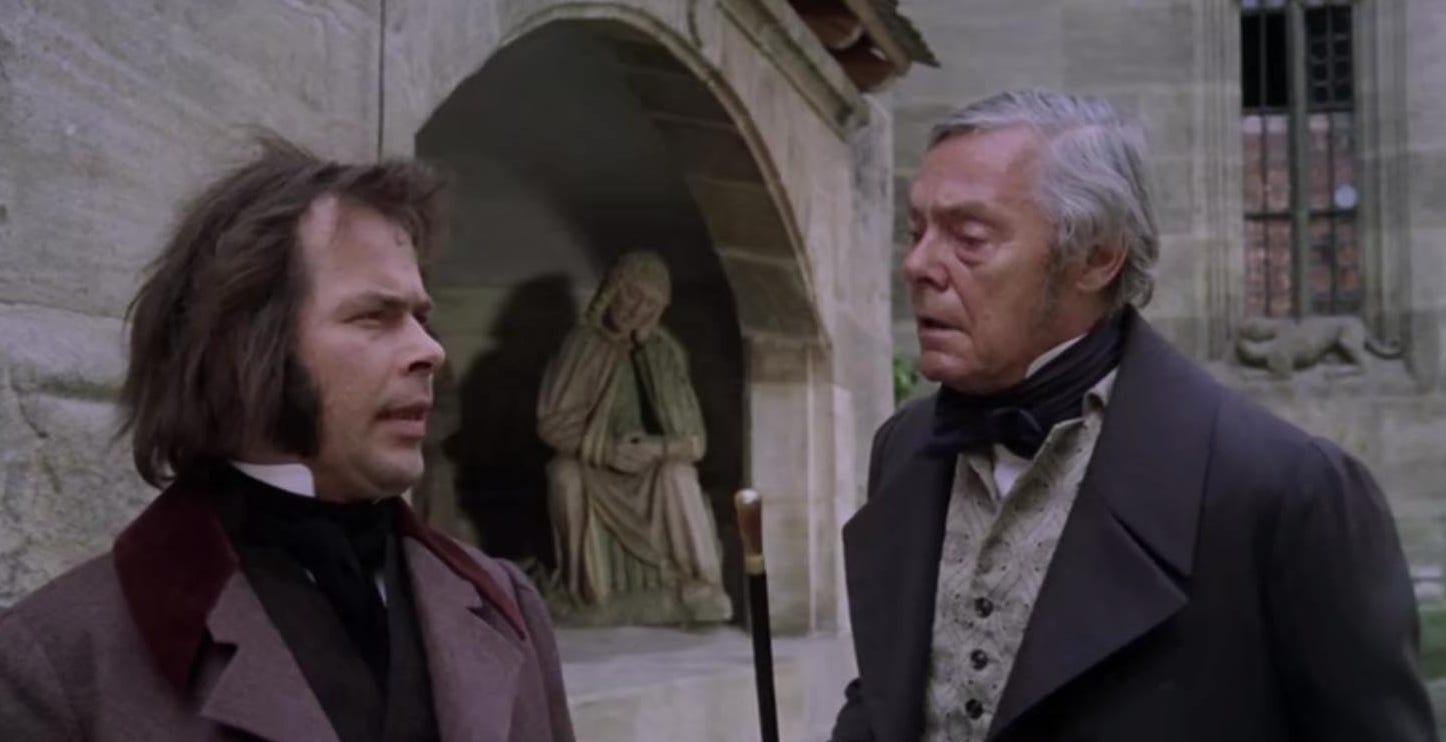
Part of Hauser’s effect on us (and, by extension, the locals) has to do with his relationship to convention. With a few words, Hauser shows how easily demolished are so many of the thoughts and practices we never question. He’s a combination of Socrates, Chance the Gardener, Puck, and Mork from Ork. When a teacher poses the famous “Knights and Knaves” problem about two places where the inhabitants either always or never lie, Hauser offers a solution that makes perfect sense but isn’t acceptable to the cold and rigid rules of formal logic. When he weeps at the beauty of the music he hears coming from a piano, he reminds us that this is the proper response to beauty—not trying to hide one’s emotions or apologizing for having been moved.
All of this is done without a hint of sentimentality: he isn’t Forrest Gump. Hauser is an object of wonder, not pity; like The Elephant Man in the hands of David Lynch, Hauser achieves his dignity by morally surpassing those who would confine him to a place (a cave, a sideshow) or a name (a freak, an abomination). Those who chase John Merrick through the streets of London are the same people who taunt Kaspar Hauser with a chicken: morons and brutes who cannot tolerate questions, doubts, or thinking. In one of his early stories, Vladimir Nabokov captures the tormentors’ view of the world:
It maddened them that despite their having got acquainted with him, a man should remain as inaccessible as before . . . It is not enough that he moves and breathes differently from other people; the trouble is that we just cannot put our finger on the difference, cannot catch the tip of the ear by which to pull out the rabbit. Hateful is everything that cannot be palpated, measured, counted.1
When Hauser states, “The people are like wolves to me,” a professor responds, “You mustn’t say that.” But he must, because one of the chief conventions that binds us together is unavailable to him: he cannot lie. In The Violent Bear it Away, Flannery O’Connor has a prophet think of Heaven as “that violent country where the silence is never broken except to shout the truth.” Hauser isn’t sent from Heaven, but he does get the same treatment as the prophets of old: hostility, anger, and death.
Hauser’s relationship to language is as striking as the rest of him. Readers of Paul Auster’s 1985 novel City of Glass will see in Hauser a kinship with Peter Stillman Jr., an adult who has been kept in solitary confinement since birth as an experiment to see if he would eventually learn the language spoken by God. Yet when Stillman speaks, the results are less than heavenly:
Peter was a good boy. But it was hard to teach him words. His mouth did not work right. And of course he was not all there in his head. Ba ba ba, he said. And da da da. And wa wa wa. Excuse me. It took more years and years. Now they say to Peter: you can go now, there’s nothing more we can do for you. Peter Stillman, you are a human being, they said. It is good to believe what doctors say. Thank you. Thank you so very much.
I am Peter Stillman. That is not my real name. My real name is Peter Rabbit. In the winter I am Mr. White, in the summer I am Mr. Green. Think what you like about this. I say it of my own free will. Wimble click crumblechaw beloo. It is beautiful, is it not? I’m making my words like this all the time. That can’t be helped. They just come out of my mouth by themselves. They cannot be translated.2
Hauser doesn’t talk like Peter Stillman Jr., but he does have his own linguistic tic: he can’t dissemble and speaks in statements that reveal, with beauty, his removal from convention. “Nothing lives less in me than my life,” he states. When describing his new world, he says, “Here, everything changes, and nothing stays still long enough for me to love it.” And he wanders into the domain of centuries of philosophers when he says, “Words are like walls: they don’t help me see things; they stand between me and the things I want to touch.” Each of these could be the subject of an afternoon’s discussion.
Hauser never tries to be poetic or strains for the most juste, but when he says, “It seems to me my coming into this world was a very hard fall,” we know exactly what he means, as we do when he argues that a room in a tower is larger than the tower itself or that an apple rolls according to its own will. He is childlike without being childish and his curiosity is an affront to those who know the formulas but none of the wonder at the world those formulas describe.

And yet they are, in one sense, the winners. The film’s final scene, detailing Hauser’s autopsy and the examination of his brain, is a triumph for those who seek to conquer the human spirit with their calipers and scales. The bureaucrats and medical men know everything of the physical but nothing of the metaphorical; they can weigh a brain but cannot fathom a mind. They are the same people we see today who reduce common human emotions into identifiable disorders and use trendy labels as if these were the end result of their inquiry. The Guardian hailing the film as “a brilliant and unforgettable take on mental illness in the 19th century” is as off-the-mark as the doctor who notes an enlargement of the liver and nods as if this explains Hauser’s behavior. The tiny stenographer who follows the mayor and ends the film thinking about the wonderful report he will write is exactly the kind of person who would never find Kaspar Hauser enigmatic; he is, instead, a solvable problem. If the team of doctors had a chance, they would do the same thing to Hamlet to explain away his melancholy disposition. Only the viewer can escape their dissection and resist the facile kind of conventional reasoning seen in our political and cultural lives. And that’s as true if you’re living in 1928 Nuremberg or 2026 New York City.
The film’s original German title, Every Man for Himself and God Against All, directly casts Hauser as a touchstone that reveals the miserable lot of man and the specific agonies of one who dared disturb the universe. Hauser’s journey from dark cave to confusing civilization is the same one all of us take and we all end in the caravan Hauser sees in a dream. There are days when none of it makes any sense and we are reminded of what Herzog says in one of his later films: “I believe the common denominator of the universe is not harmony, but chaos, hostility and murder.” Yet our being moved by Kaspar’s story—and by art in general—at least signals that Herzog might be generalizing. The coroners can’t see what we do, and perhaps our vision of Hauser is more accurate than theirs. Herzog’s certainly is.
You can find this week’s episode of Fifteen-Minute Film Fanatics in which we discuss The Enigma of Kaspar Hauser wherever you get podcasts. Please subscribe to the show and consider leaving a review on Apple Podcasts or Spotify.
Vladimir Nabokov, “The Leonardo” in A Russian Beauty and Other Stories (New York: McGraw-Hill 1973) 16, 18.
Paul Auster, The New York Trilogy (New York: Penguin 2006) 18-19.
Walking down Main Street of Lexington, while I was a student at the University of Kentucky, so this was probably 1983 or 84. I passed the Kentucky Theatre and glanced at the schedule. A film I had never heard of by a director I had never heard of was just about to start. But the title: Every Man for Himself and God Against All was my ticket in. I walked out of the theater after the movie wanting to know everything I could about Werner Herzog. I tried, unsuccessfully, to talk others into seeing the film. My description perhaps didn’t do the film justice. Perhaps they were like the physicians performing the autopsy.
This film sounds a lot like Jerzy Kosinski's novel Being There(film with Peter Sellers is great as well), have to wonder if he got his idea from this Hauser situation. All these references point to societal conditioning being the culprit in the war against truth, those that embody truth are often scorned and beaten down by society at large.