

The Sound of Thinking
Audio and Ideas

I recently attended a conference at Princeton called Audio and Ideas. The program promised panels of speakers addressing the conference’s theme:
Podcasting is already a medium for scholarship, and there are dozens of so-called “academic podcasts” in existence. Indeed, the New Books Network aggregates an enormous number of podcasts on everything from political science to literary theory. However, the majority of these podcasts consist of “author interviews,” which use only a fraction of audio’s potential to reach the listener the way that highly produced, scripted, expertly sound-designed and edited podcasts are doing in other parts of the culture. There is an opportunity for scholars to take charge of their own productions, and serve a growing intelligent public that is increasingly turning to podcasts to both continue its education and learn about the pressing issues and topics of our time. It is a public intellectual problem, for which audio journalism has an answer.
The panels will address the way intellectuals of all kinds are using audio to generate new scholarship. While the commercial podcast universe has expanded and contracted in the past decade, the world of academic podcasting has grown at a steady, if modest, pace. This may present the university with an opportunity. At a time when the market has turned its back on highly produced podcasts, perhaps this is a good time for intellectuals of all stripes to explore the possibilities of idea-driven, narrative audio work within the context of the academy.
When Johnson noted that “promise, large promise is the soul of advertisement,” he could have also been talking about conference descriptions, which can be like the picture of Dorian Gray. I’ve presented to crowds of four or five and have also seen presenters reading their papers, heads-down, with the enthusiasm of five-year-olds being served lima beans. So I went into this one with the understanding that if it wasn’t as good as the description, I could at least walk around campus and visit the record store.
My reservations were wonderfully put to rest after only a few minutes. The discussions made me rethink some of my initial assumptions about how scholarship can be delivered to the public.
Robert Boynton from NYU began by noting the difference between long-form narrative podcasts and “chat” ones, where two or more people talk about a book, idea, movie, food, historical event—whatever excites them. Academics tend to think that chat podcasts are basically the whole arena: you have an idea, talk about it, and other people listen. But Boynton said, “Chat should be the floor and not the ceiling for what we do” and encouraged academics to think of how narrative, professionally-produced podcasts can deliver scholarship to an eager audience.
I was skeptical. A podcast could complement research and scholarship, but it’s still a notch below print, the way that graphic novels can be great but not as great as, well, traditional novels. This isn’t to diminish books like Watchmen, which I’ve taught, but to draw a distinction between forms: one simply cannot do in a graphic novel what one can in a novel, just as one can’t do in a podcast what one can do on a page.
Several of the panelists, however, made me reconsider those assumptions. Media historian Mara Mills spoke about her work in Sound Studies and her interest in the social, political, and cultural implications of reproduced sound. Even what we call “the chipmunk voice,” as she pointed out, has a history that reveals aspects of the world that created it. She played a clip from a podcast she had created concerning time-stretching. We’ve all (literally) heard this: a speaker’s voice is slowed to match a rhythm or sped up to read a disclaimer at the end of an ad. The clip featured Mills discussing time-stretching and illustrating it at the same time, which touched upon the history of tweaking the playback speed of human voices and what this meant for listeners. “Academic publishers can’t fund audiobooks,” she said, “so we tried this.” The takeaway was that the podcast was able to get across the ideas about time-stretching in a way that could not be conveyed on the page; it allowed her to demonstrate, not simply describe, the subject, which then made it easier to move into a discussion of how time-stretching connects to ideas from physics and assumptions about the nature of time.
Fanny Gribenski shared a clip from a narrative podcast she created about her upcoming book The Elephant in the Piano: Music, Ecology, Empire. “At the turn of the century,” she explained, “pianos were everywhere” as a symbol of clout; her podcast takes the listener through the physical components of the piano—the wood, ivory, iron, and felt—to reveal how the status-symbol connects to the history of capitalism. She joked and acknowledged that whenever an academic needs a subject, they can always resort to “the history of capitalism,” but in this case, the connection made sense. She played a clip in which she interviewed someone who makes piano soundboards out of spruce; as with time-stretching, the audio experience, the hearing what the spruce could do, made the points more immediate than they could be made on the page.
We praise writers for their use of sensory imagery; here, we had writers literally involving their audience’s sense of hearing as a means to show what reading could convey only by proxy.
During the Q&A, someone asked about these projects and said, fine: scholarship about time-stretching and the piano naturally lend themselves to audio. But what about philosophers? What about, say, some academic who thinks about Kant or natural rights? Podcaster and producer Benjamen Walker immediately said, “That’s so doable” and talked about how even the most abstract philosophical pursuits could be dramatized. Everything that can be printed can be reimagined and presented in audio—not as audiobooks, but as narrative podcasts that make ideas understandable to anyone interested in them.
Other panels featured The New Yorker’s Vinson Cunningham, who co-hosts their podcast Critics at Large and Chenjerai Kumanyika of NYU who co-created Uncivil, a podcast that (as noted in the show’s description) “ransacks” the official history of the Civil War. Kumanyika smiled as he said that in the academy there’s definitely “a little looking down the nose” at podcasts, which made me again think back to my opening skepticism. The best podcasts, he added, are those in which “the form and understanding come together”: the goal is to invite the listener into the experience of learning and use the conventions of audio drama to make that experience meaningful. He also spoke about the differences between traditional peer-review and working with a professional podcast producer, noting that peer-review is an important process, but that the feedback a scholar gets from a producer is almost immediate and sometimes far more intense.
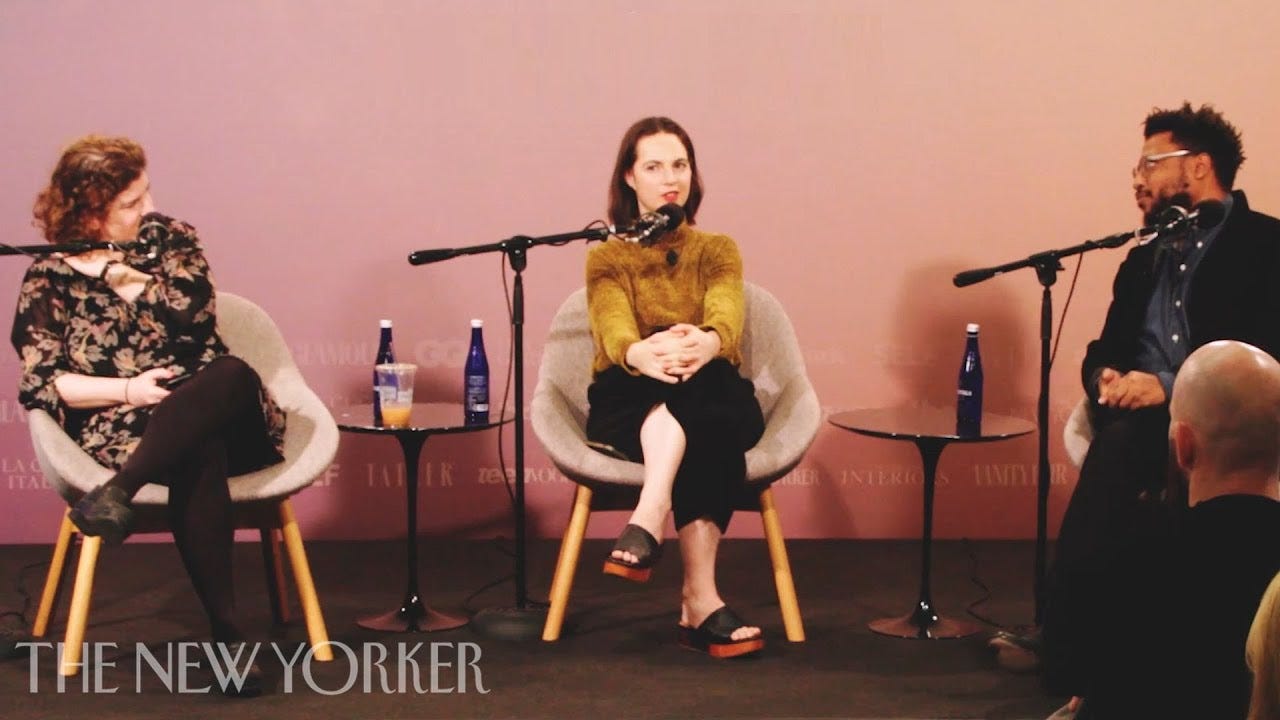
Cunningham spoke about the format of Critics at Large and said, “Suddenly, no one thinks dialogue can be substantive,” reminding me of the earlier remark that chat should be the floor and not the ceiling. Cunningham repeatedly reminded us of how good conversation doesn’t just demonstrate knowledge, but helps create it. This stuck me as absolutely true: my Fifteen-Minute Film Fanatics co-host and I always say that after we record each show, we’ve come to a much richer understanding of the film in question that we couldn’t achieve alone. Solo podcasting is very difficult, making this man’s work all the more incredible. Knowledge created through the sound of conversation was also what was happening in this very room: the more the panelists talked to each other, the more I learned.
During a pause, producer Jody Avirgan (FiveThirtyEight), offered a great insight into what makes a chat podcast engaging. Asking, “Where are the speakers in terms of the audience?” he motioned back-and-forth across the table, saying, “If the audience imagines the two speakers as sitting this way”—facing each other—“that creates one experience. But if you imagine them shoulder-to-shoulder, both looking at the same interesting thing, the conversation becomes more exciting.” That struck me as absolutely true: everybody loved it when Siskel and Ebert bickered, but they agreed much more often and it’s those conversations that taught so many people how to talk about movies. The shoulder-to-shoulder model is also the core technique of great teachers, who don’t tell you things about a subject (or, worse, read you slides about them), but instead ask you, “Isn’t this cool?” and invite you into their enthusiasms. A person admiring Hamlet with other readers and talking about how it works is often more engaging than the same person stating why it’s a great play.
After we listened to an example of this shoulder-to-shoulder dynamic from an episode of Critics at Large, Cunningham said that he was acutely aware of the “likes” and “ums” in his statements. I sympathized; we’ve all been in a situation where we are listening to ourselves for some reason and cringing at how we actually sound. During the Q&A, I asked him about what would happen if his “mistakes” were edited out: he’d sound like AI, and wouldn’t that cost him his authenticity?” He agreed and (to my delight) quoted Henry James’s The Bostonians, when Olive Chancellor yearns for someone to articulate her co-feminists’ struggles: “A voice, a human voice, is what we want!” He added that ideas concerning “authentic audio” have not always been as they are now: radio actors used to read quotations from people not “trained” for the medium. Like the chipmunk voice, the allowing for “ums” and “likes” has a history. This idea of what makes a recording “authentic” reminded me of the terrific book Live Dead, which uses The Grateful Dead to tell the history of why music lovers have come to value live music more highly than studio work. (This valuation seems, like so many of our ideas, intuitive and “natural,” but there’s a story behind it that concerns audio technology and, yes, the history of capitalism.) When filler words and even some vocal tics are present, they make a conversation more authentic for the listener, which makes the listener more invested and, in turn, more likely to learn something. Listening to a good chat-podcast is like eavesdropping on live thinking.
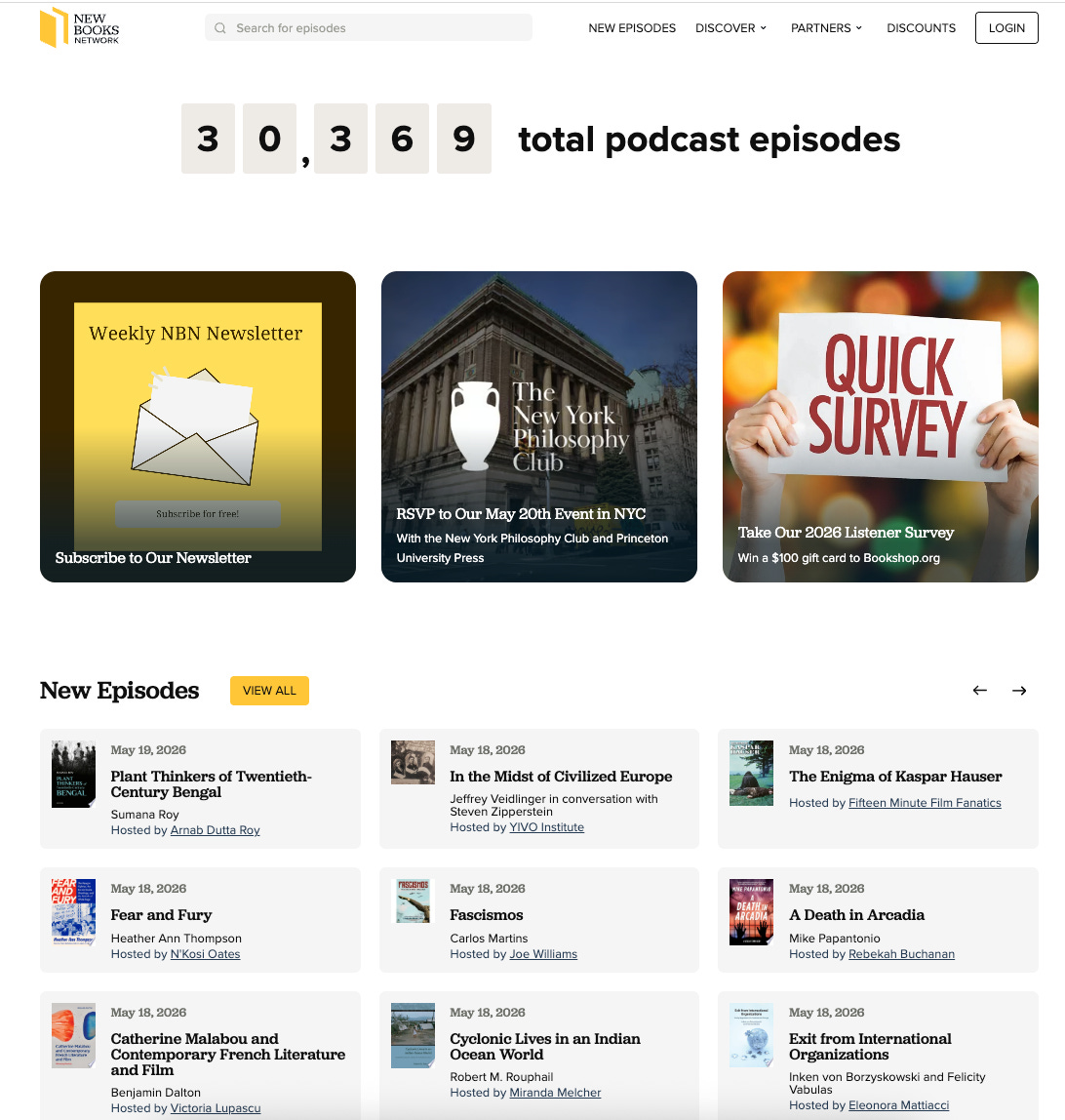
Caleb Zakarin, CEO and Publisher of The New Books Network, added that an author interview—pure “chat”—may not have a narrative arc, but when a listener can move from not understanding to grasping a big idea, there is kind of a story taking place. Since 2022, when I began as a host on the NBN, I’ve tried to make these stories happen by making the interviews shoulder-to-shoulder experiences that bring ideas in the books closer to the listeners. This has happened in conversations about subjects ranging from Beowulf to the First Amendment, from off-gridders in Colorado to Bob Dylan, from economics to the films of Albert Brooks. Authors begin as enthusiasts for an idea, work or art, or historical event and it’s my goal to share this enthusiasm with the listener. (This is one of the reasons why I always read the books beforehand: nothing is easier to spot than feigned enthusiasm.)
After the panels, Caleb introduced me to someone whose podcast, like Fifteen-Minute Film Fanatics, is also distributed by the NBN: Ryan Shinkel, the producer and host of Madison’s Notes, the official podcast of Princeton’s James Madison Program. After a minute, he asked me, “Wait—you’re Dan from Fifteen-Minute Film Fanatics?” It turned out that this was my first in-person meeting, since the kickoff in 2020, with a bona fide listener who wasn’t connected to me by blood, address, friend group, or workplace.
For providing sourced scholarship, nothing will soon replace the written word. But a podcast can present ideas in a form that can, if listeners desire, send them to articles and books. Narrative podcasts offer edited, polished thinking that’s already happened; chat podcasts offer less polished but more spontaneous thinking as it occurs in real time. Conversation-based podcasts allow us to vicariously think along with the hosts, just like people watching sports, in a sense, play along with the athletes: in the best moments of each, we become a little more than spectators. And the best chat podcasts seem to resemble narrative ones in generating curiosity, although in chat the plot isn’t based on what will happen, but what somebody will say. A great conversation, whether it’s about an idea, book, event, or relationship, always includes a level of suspense.
Interesting. Shall think about this. I don't much listen to podcasts for whatever reason. But the older I get, the more obsessed with the idea of conversation I become. A few days ago I bored the hell out of a friend by emailing her a long passage from Oakeshott's essay 'The voice of poetry in the conversation of mankind'. Nice use of Johnson, by the way.
I think we take for granted how skill-intensive chat podcasting is. I listen to a lot of podcasts that interview academics, and very few of the guests are both engaging and pleasant to listen to for long stretches of time… especially when I am so spoiled by Holland & Sandbrook of The Rest of History, who make it look diabolically easy.