

I'm Here to Amuse You
The Trip and Male Friendship

This essay accompanies this week’s episode of Fifteen-Minute Film Fanatics, a podcast that always breaks the premise of its title but never wastes the listener’s time. The post and the podcast complement each other; the post isn’t a summary of the podcast, so please give it a listen. We take requests; leave a comment below if there’s a film you’d like us to cover. We’ve done over three hundred episodes that you can find on Spotify, Apple, or wherever you get your podcasts. There’s also a player at the end of this post. Check out the back catalogue for episodes on your favorite films. It’s free everywhere, fueled by enthusiasm. Thanks.
Historian Stephen Ambrose’s Comrades is an exploration of male friendships: how they begin, how they are challenged, and how they endure. He talks of his own family, but also Eisenhower, Custer, Crazy Horse, and Nixon (as a foil to the others). He predictably treats Meriwether Lewis and William Clark— “predictably” because his previous book about them, Undaunted Courage, boosted his readership and nationwide interest in the Corps of Discovery. Ambrose tells us that the two men nursed each other physically: Lewis pulled thorns from Clark’s feet and Clark had the less-glamorous job of treating an accidental gunshot wound to Lewis’s rear end. But they also took care of each other socially and emotionally. Lewis, Jefferson’s first choice, made sure that Clark was considered his equal in terms of rank and reputation. Clark named his first son Meriwether Lewis Clark and was greatly pained by his friend’s later bankruptcy, decline, and suicide. Ambrose concludes:
Perfect friendship is rarely achieved, but at its height it is an ecstasy. For Lewis and Clark, it was such an ecstasy, and the critical factor in their great success. But even at its highest, friendship is human, not godlike. For all his efforts and intentions, Clark could not save Lewis. But they gave to each other everything that can be drawn from a friendship, including their finest moments. Through their trust of each other they put themselves into the top rank of world explorers. And they gave to their country its epic poem while introducing the American people to the American West.
About 200 years before Lewis and Clark’s first meeting, Shakespeare wrote a scene in which Hamlet describes to Horatio why he values him so greatly:
Thou hast been
As one in suffering all that suffers nothing,
A man that Fortune’s buffets and rewards
Hast ta’en with equal thanks […] Give me that man
That is not passion’s slave, and I will wear him
In my heart’s core, ay, in my heart of heart,
As I do thee.—Something too much of this.—
That last phrase, meaning, “I’ve said too much,” is said because Hamlet realizes that he is starting to sound more sentimental than an avenger should; it’s like a moment in a cartoon when a hero shakes his head back and forth to restore it to its proper shape. It also reflects an understanding among men that their friendships should be enjoyed but not discussed.
I daresay that many of us have not experienced the ecstasy described by Ambrose or spoken to our friends as directly and deeply as Hamlet speaks to Horatio. My friends and I have not given to any country its epic poem; the most we’ve given it is a podcast.
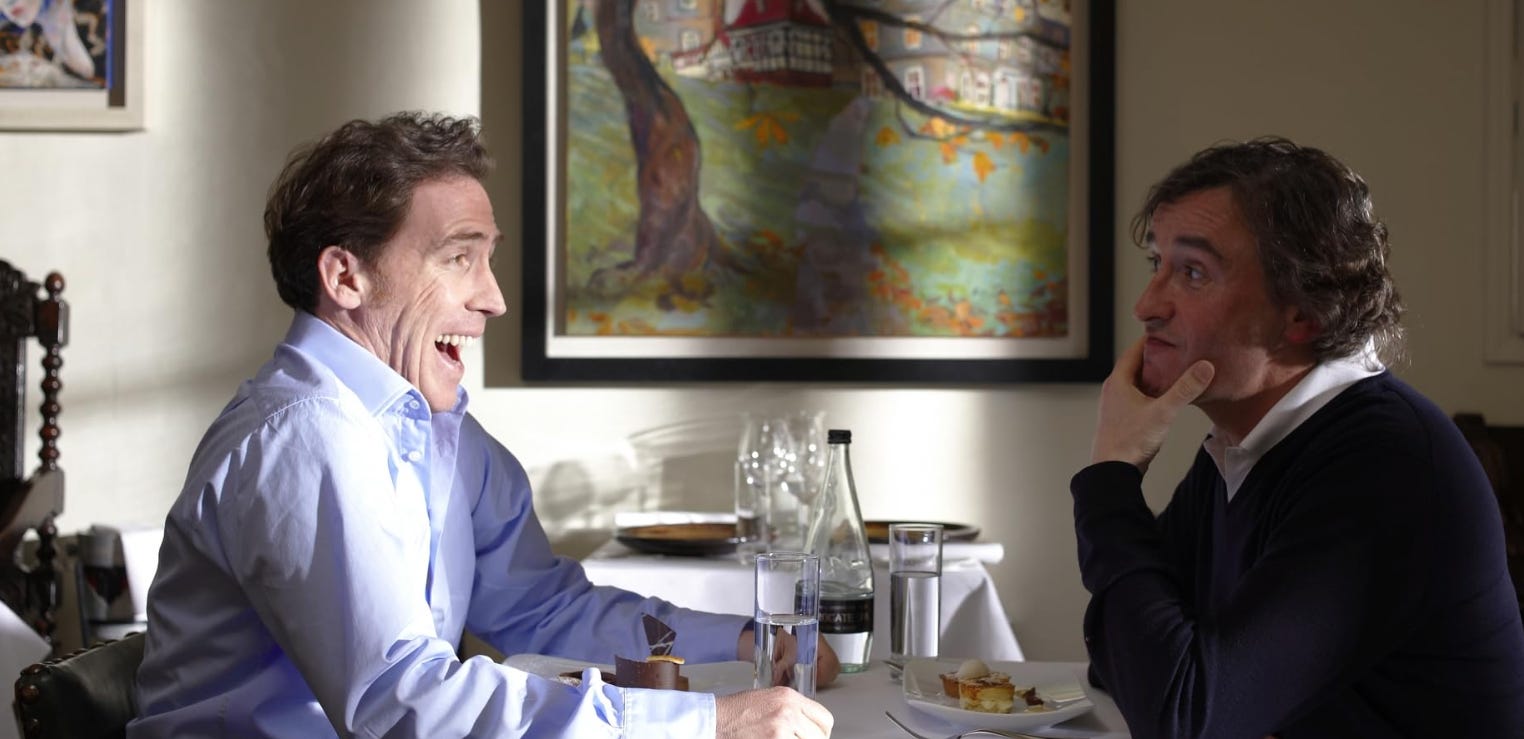
The Trip (2010) is wholly unlike Ambrose’s or Shakespeare’s portraits of male friendship; the figures are not explorers or poetic princes, but they demonstrate what many men want from their friends and what makes friendships work. Rob Brydon and Steve Coogan are clearly close, yet never reach any “ecstasy” (the restaurant reviews are not “England’s epic poem”) nor tell each other why they value their company. Their friendship is based not on mutual respect or deep-seated needs, but on the factor that drives and sustains many male friendships: they find each other endlessly amusing. They like the same songs, the same films, and the same actors. Men can befriend other men from across the political aisle, but a man who loves Stanley Kubrick will have trouble connecting with a guy who thinks 2001 is boring.
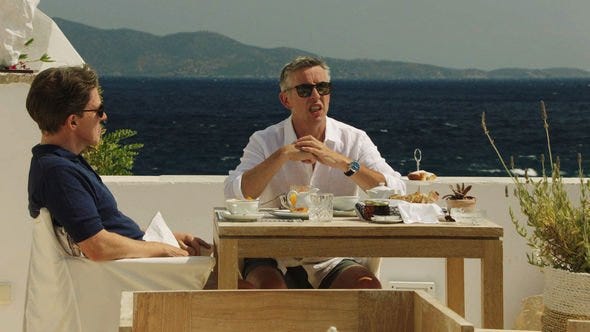
What’s perfect about The Trip (and television series from which it is drawn) is that we see a demonstration of raw friendship: Rob and Steve aren’t exploring the Louisiana Purchase or trying to catch the conscience of a king. Their friendship is essentially plotless. They drive, eat, and walk around. There are no adverse situations that tighten their bond or make them look inward; they are killing time as best they can and filling that time with conversation. And through these conversations, we see they like each other not out of any depth of feeling or political ties or shared experiences, but because each can make the other guy laugh.
My Dinner with Andre uses the simple premise of two men sharing a meal as a vehicle for exploring how we should live. Andre and Wally debate fundamental questions about happiness and self-fulfillment and grow closer even as their visions of the world seem far apart. The Trip uses the same premise as a way to dramatize two men earnestly debating who does better impressions of Michael Caine. However, just because the subject seems slight does not mean that Rob and Steve approach it with any less seriousness than their predecessors. They argue about who does better imitations because that’s important: they care about movies and demonstrating how well they know their subjects. If they were arguing about politics, the film would lose all of its charm. Besides, who can say, “Come, come, Mr. Bond, you know you enjoy killing as much as I do” more perfectly is exactly the kind of contest into which so many men have entered with their friends, who spend much more time jabbing than complimenting each other because jabbing is funnier.
That so much of their time is spent imitating celebrities is another perfect window into male friendships. It’s the same as children imitating superheroes by tying beach towels around their necks and throwing dirtbombs. There are rules that must be obeyed: just as you can’t say you want to be Batman and then pretend to have a gun, you can’t claim you can mimic late-career Michael Caine and not account for the brandy and cigars. Men take their foolishness seriously and want their friends to recognize it. Women couldn’t be bothered.
One of the reasons why the most quoted scene in Goodfellas works so well is that its intensity sneaks up on the viewer. Henry (Ray Liotta) wipes his eyes from laughing and says to Tommy (Joe Pesci), “You’re really funny.” That Tommy would be offended by this praise is what rattles Henry (and the viewer): this is one of the highest compliments one man can give another. Why would it upset him? When Tommy asks, “Am I here to amuse you?” Henry can only stutter, but if this were asked by someone other than a hotheaded gangster, the logical response would be, “Well … yes. Isn’t that one of the big reasons we’re even sitting at the same table?” That Tommy then reveals the whole thing to be a joke perfectly reflects the male drive to get a laugh from the other guys at the table. Making the other guy fear for his life only sweetens the punchline.
Just as The Trip is largely improvised, so are friendships, more so than other relationships. Work somewhere for a year or two and you’ll be expected to think about promotions. Date someone for a year and you’re expected to think about marriage. Get married and you’ll be asked, often obliquely, if you’re going to have children. So many relationships move according to unspoken yet widely-acknowledged scripts, but friendships are allowed to progress in whatever way they do. You might spend almost every moment of two weeks with someone, sharing hotels and meals and time in a car and then not see him for another year (which is how the series justifies itself at the start of each season). Episodes also end frequently on downbeats in which one of the two gets a phone call reminding him of the real world at home or contrasting scenes of the two in their separate rooms, thinking about different things. Friendships are like that, too.
The twenty-four Trip episodes and four films drawn from them become less funny as they proceed; I’ve watched every minute and the first six episodes have the biggest laughs, possibly because the setup is new to the viewer. When they do Roger Moore or “Guess the Bill” the first time, it’s hilarious; by the fifth or sixth, less so. Yet even when the show isn’t as funny as it was, there’s a comfort in watching it because you’re still at the table. You might not have big laughs with your friends every time you see them, but that you occasionally do is why you keep coming back. It’s like being an amateur golfer: there’s a lot of down time and occasional frustration, but when things click it’s tremendous fun and you forget all of the irritation. The Trip to Greece isn’t as funny as The Trip, but it’s still amusing. And by episode 24, we don’t want to end our friendship with Steve and Rob, which explains why The Trip was just renewed for a fifth season in which they visit Scandinavia.
When we recorded our episode on Paths of Glory, Mike and I got into a heated debate about the meaning of the ending—one of the few intense back-and-forths we’ve had. We each dug in our heels to the point that we kept arguing, over texts, long after we had finished recording. I even asked one of my friends to be an impartial judge, the Solomon who would stop our bickering. (He texted us, “You’re both wrong.”) When I said later that we were arguing about something not all that important, the end of an old movie, Mike said no, movies are important and worth debating. And he was right: arguing about a movie, like imitating celebrities, is a means by which a friendship is sustained.
Something too much of this.
Listen wherever you get podcasts or here:
Thanks, Daniel. So enjoyed reading this (especially on a damp Friday afternoon). My friends and I adore The Trip, and "earnestly debating who does better impressions" pretty much sums the three of us up. I've lost count of how many times we've said, why haven't we been put on TV because this is what we do?! Anyway, great stuff, and looking forward to reading more of your pieces. Happy weekend!
I'd put off seeing 'The Trip,' for no good reason. But that you mark it's parallels to 'My Dinner with Andre,' one of my favorites...maybe it's one to sit down with, after all. Great piece.