

Look at Me
Confidence and Criminals

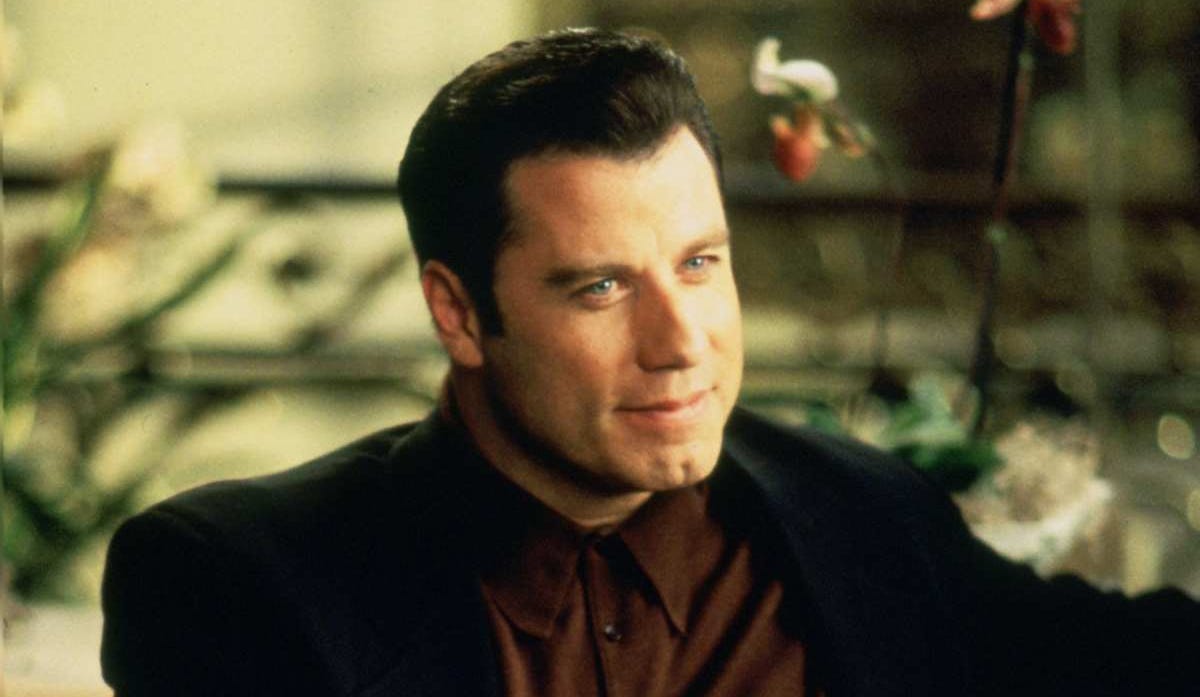
Look at me.
When’s the last time you said that to somebody who wasn’t one of your kids? And note that this isn’t followed by, “When I’m talking to you,” to which, when our mothers said it, we responded with an exaggerated, bug-eyed grimace in a lame attempt at salvaging our dignity. I mean it as three monosyllables said as plainly as, “Let’s clean up,” without raising one’s voice or implying “or else.” Most of us would be hard-pressed to remember a time when we said this to someone and meant it.
In Barry Sonnenfeld’s Get Shorty (1995), Chili Palmer (John Travolta) says this more than once and means it every time. As a loan shark who deals with sometimes irrational and often dangerous people, he controls situations that could go sideways by projecting confidence and authority. He doesn’t carry a gun because he doesn’t need one; his greatest weapon is his attitude. Naturally, there are times when someone needs to be punched in the face, but Chili’s confidence usually prevents things from getting to that point; he only hits Ray Bones (Dennis Farina) because he’s a fellow traveler in mobland and only understands fists and bullets. On the pages of Elmore Leonard’s 1990 novel and in the frames of Sonnenfeld’s adaptation, Chili gives a master class in confidence: he makes being cool look easy, even when he’s driving a minivan. The film’s funniest scenes are when second-tier producer Harry Zimm (Gene Hackman) tries to act like Chili on the phone—
—and when Chili gives a line reading to actor Martin Weir (Danny DeVito):
We’re all like Harry and Martin, trying to be as cool as the people that impress us, but often falling short by saying something too off, too loudly, or trying too hard, like the readers of Troy McClure’s self-help book, Get Confident, Stupid! None of this is stated in the film, but it’s dramatized through Chili’s interactions with other people. Small wonder that Leonard titled his sequel, in which Chili becomes a record producer, Be Cool. Almost all of his novels could have that title: it’s the Leonard ethos.
As Chili follows one of his debtors to Hollywood, he sees the truth in William Goldman’s famous description of the film industry: “Nobody knows anything.” He therefore uses the same skills he learned in Miami to make a movie, swapping one set of criminals for another. We watch him construct the plot of a potential film—based on events to which he is responding—with Chili often saying that he doesn’t know how it will end. Like his creator, he works by instinct and his confidence carries him along: many of us can’t deal with the uncertainty of when the cable guy will arrive, much less how we’ll deal with drug kingpins, capos, and federal agents all homing in on us. In a 1998 interview, Elmore Leonard explained (as he did throughout his career) that he worked by creating interesting characters, putting them in the same place, and seeing what would happen:
Plot is secondary, not that important to me. Once I know my characters I’m confident a plot will come out of them. I make it up as I go along, not knowing what’s going to happen, never knowing how the book will end.
In a 2009 essay, he said, “At the time I begin writing a novel, the last thing I want to do is follow a plot outline. To know too much at the start takes the pleasure out of discovering what the book is about.” Anyone great at something makes it look easy, and this is Leonard doing just that. His remarks are illuminating because the plots of his books are so well-crafted that we think that he must have worked backwards: the ends of his books seem spontaneous when they happen yet inevitable when we look back.
Get Shorty was born of Leonard’s thinking that his interactions with Hollywood types from the many adaptations of his work would make a good book. But the novel began with its protagonist, not any desire to satirize or “reveal” anything about the film industry. Again, from the 1998 interview:
I knew a guy named Chili Palmer who worked for Bill Marshall, an old college classmate of mine who was now a private eye in Miami. Chili was a former loan shark who did surveillance on cheating husbands. They made quite a team. Marshall could not open his mouth without saying something funny. Chili could put on a look of cool menace whenever he wanted.
That look of cool menace appears throughout the film, accompanied by, “Look at me,” and each time it does, we are reminded that Chili is one of Leonard’s good-bad-guys, like Jack Foley (George Clooney) in Out of Sight. He’s a criminal, but he’s also a movie criminal, so we’re drawn to his charm and side with him. Even his name is perfect: Leonard was speaking of a time before being “chill” meant “unmoved” or “relaxed,” but since then, the language has caught up with him. Anyone who would object to Leonard’s work on moral grounds that he’s glorifying criminals is missing the point—and likely not very cool.
Chili’s a movie criminal, but he’s also a criminal who loves movies. In the opening scene, he says that his boss, Momo, should buy a movie theater from someone who owes him money and let Chili run it: “I could show some old Cagney movies.” He describes his stolen coat as “a black leather jacket, fingertip length, like the one Pacino wore in Serpico.” When he arrives in Hollywood, he asks Karen Flores (Rene Russo) if she’d like to see Touch of Evil with him, and later we see him in the theater, saying the final lines along with the actors. (Nobody there does what I do when people talk during a movie.) When Karen starts a line by Bette Davis, Chili finishes it: “I’d kiss you, but I just washed my hair.” And when cocaine dealer Bo Catlett (Delroy Lindo) catches Chili in his house, they have this exchange:
BO: You broke into my house, and I have a witness to it.
CHILI: What?
BO: Only this time it ain’t no John Wayne and Dean Martin shooting bad guys in El Dorado.
CHILI: That was Rio Bravo. Robert Mitchum played the drunk in El Dorado. Dean Martin played the drunk in Rio Bravo. Basically, it was the same part. Now John Wayne, he did the same in both. He played John Wayne.
Bo’s response, “Man, I can’t wait for you to be dead,” is a sentiment felt by some people when they’re in the presence of film fanatics who correct them about titles, release dates, and plot points. Leonard has such confidence as a writer that the can set up the talking killer trope and still make it funny.
Like Sunset Boulevard and the original A Star Is Born, Get Shorty is a movie about the industry, but unlike Billy Wilder’s or William Wellman’s dark, ironic visions, Get Shorty never attempts to show the effects of fame or what happens when the pictures get smaller. It’s much closer to the joyful and ever-satisfying Singin’ in the Rain: both films are filled with and made by people who love the movies and while the characters in Get Shorty never sing, their dialogue is often as catchy as the songs in musical comedies. Each film has a confident leading man who has an amusing sidekick and initially improbable love interest; each film ends with the making of a film based the one we have just finished watching; and each celebrates the industry while gently teasing the egoists (Lina Lamont / Martin Weir) that appear on the screen. Chili is the wish-fulfillment of all of us who love movies and wish we had the confidence to arrive in Hollywood, without knowing anyone, and start over as producers. But since we can’t, we watch Get Shorty and pretend.
You can find this week’s episode of Fifteen-Minute Film Fanatics in which we discuss Get Shorty wherever you get podcasts. Please subscribe to the show and consider leaving a review on Apple Podcasts or Spotify.