

The Restaurant Stunt
Boiling Point

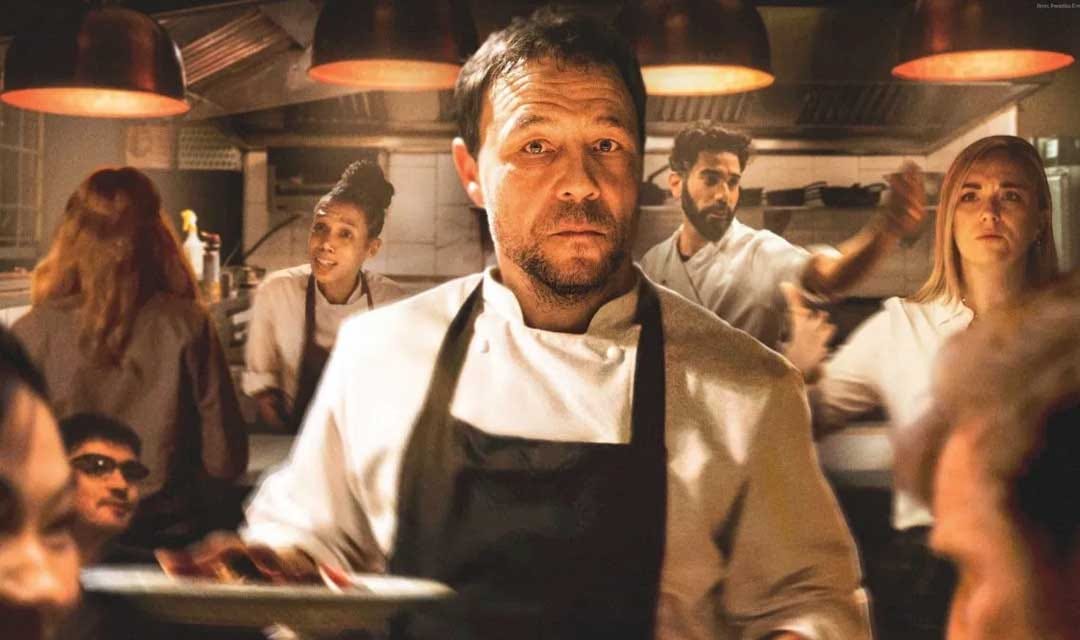
The American novelist Stanley Elkin (1930-1995) had a good run in the 70s and 80s, but is likely more known to readers as the originator of an oft-quoted sentence: “I would never write about anyone who is not at the end of his rope.” That rule is as good a piece of advice as Strunk and White’s “Omit needless words” or Elmore Leonard’s, “Try to leave out the part that readers tend to skip.” We all respond to stories in which characters move down their ropes over the course of the first hundred pages or hour of screen-time–and the character need not be a good guy. We follow Richard III as closely as we do George Bailey. The tension is found in whether or not they can climb back up.
Philip Barantini’s Boiling Point (2021) takes Elkin’s rule so seriously that its protagonist, chef Andy Jones, is already hanging from his rope over the crocodile pit when the film begins. Action movies work towards the moment when the hero has to defuse a bomb; Boiling Point begins with the hero having already cut the wrong wire. And again like an action movie, Boiling Point is a master class in stunt work, despite the fact that there are no bombs, guns, car chases, knife fights, or people jumping through windows.
The film is one long stunt, performed and shot in one take. From the time it begins until its 92nd minute, the camera never cuts away from the speaker, making the film as wonderful a piece of movie choreography as Singin’ in the Rain’s “Good Morning,” Yakimia Cannutt’s leaping across the doubletrees in Stagecoach, or Popeye’s pursuit of Frog One in The French Connection. At any random moment, the viewer of Boiling Point will consider where the camera and sound people are standing and wonder how they will seamlessly move from one part of the restaurant to the other; the viewer will also be amazed that none of the actors have the luxury to flub a line or miss a mark, lest the film need to be—quite literally—restarted from the beginning. And yet the most incredible thing about Boiling Point is that being reminded of its (for lack of a better word) gimmick doesn’t detract from the intensity of the drama. It’s exhilarating.
To illustrate by counterpoint: Quentin Tarantino’s Death Proof (2007) is an homage to the exploitation films of the 70s that, by now, we all know Tarantino adores. It’s not a parody, but an act of recreation: everything in the film is meant to evoke the experience of watching it in a theater in 1974 with lousy projection and sound. Therefore, we get the “Feature Presentation” graphic, the long credit sequence with a notably 70s font, the obvious rear projection of the road, the right music, the grainy print (filled with blips and hairs and squiggles), the occasional missing frames (where someone presumably tried to fix the editing), and the climactic fight scene with freeze-frames and overdone sound effects as Kurt Russell is repeatedly punched in the face. It’s all perfect in the moment yet not for the duration; the perfect mimicry kills the viewer’s investment in the story. Tarantino’s Jackie Brown is a much better film in every way—and one that also feels more like a 70s movie. Death Proof is meant to evoke a specific genre, but the point is that once the formal elements become the draw, there’s little incentive to get involved. In Jackie Brown, we want her to win; Death Proof begins with its director already the winner. As Peter Griffin would say, it insists upon itself.
That never happens with Boiling Point, despite its audacious technique.
The one-take technique used in Boiling Point lends an urgency to the whole enterprise. The viewer becomes involved in the tension of the crew as well as that of the characters. This rare phenomenon was last seen in 2023, when much of the publicity for Mission:Impossible Dead Reckoning centered around Tom Cruise’s continuing to do his own stunts and riding a motorcycle off of a 4,000-foot cliff: when we see the stunt, we are simultaneously nervous for Tom Cruise and Ethan Hunt, just as we are for Jackie Chan and Chan Ka Kui in Police Story or Buster Keaton and William Canfield Jr. in Steamboat Bill. Everyone in Boiling Point is at the ends of their ropes and as each scene continues and the viewer thinks that the take hasn’t ended, the stakes only get higher. Of course, we know that the stunt will work, just as we know that Cruise, Chan, and Keaton will survive, but the power of movies is so strong that we still become involved.
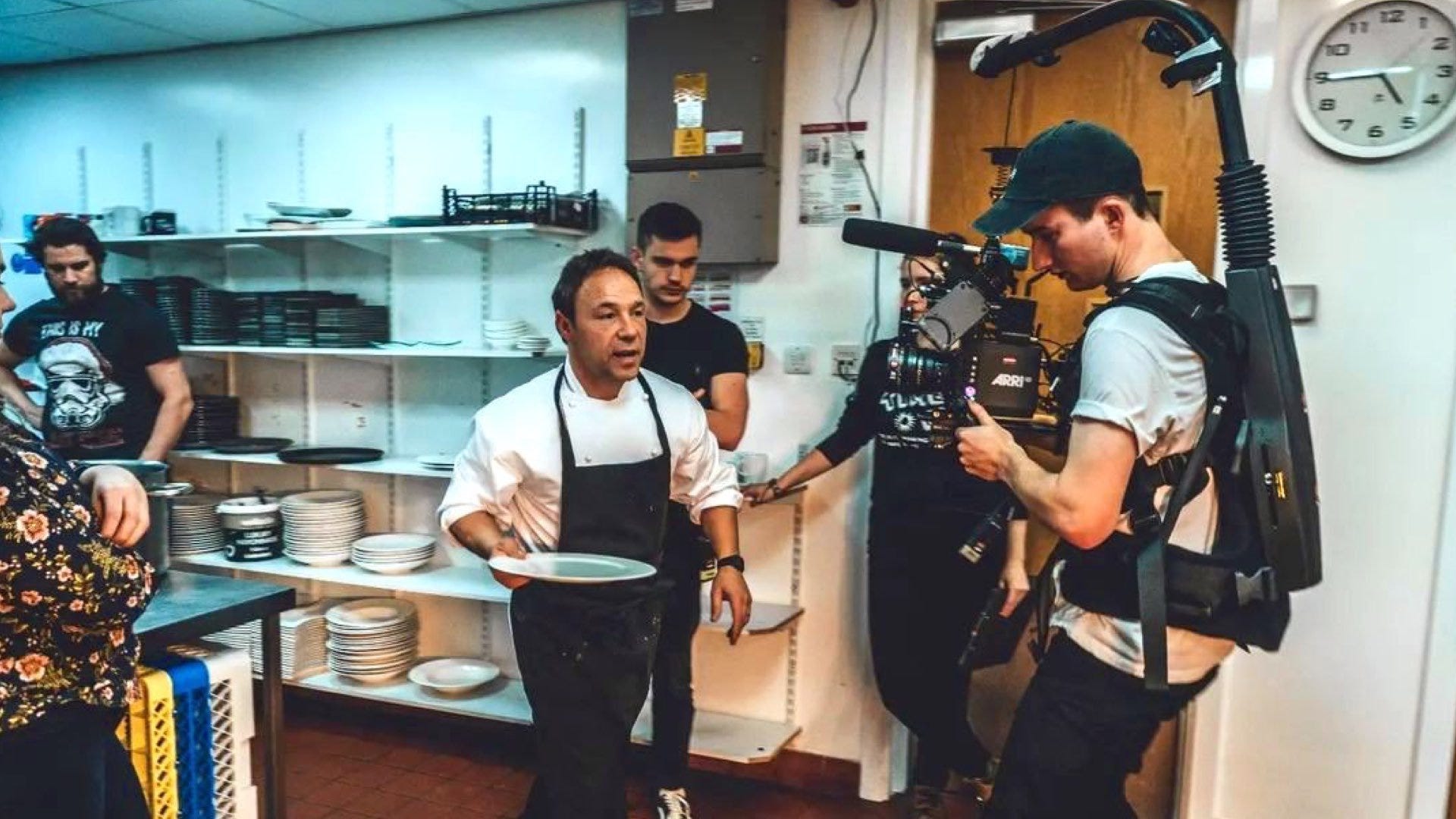
Boiling Point began as a short and was then developed into a feature. The film was shot four different times; the one we see is the third. We love watching blooper reels; the ones for Everybody Loves Raymond and Seinfeld are often better than the actual shows. But it’s impossible to imagine a blooper reel for this. Who would giggle at a flubbed line 53 minutes into the scene? It would be like laughing at a blooper for Mission: Impossible in which a parachute didn’t open in time.
Even more to Boiling Point’s credit, the film has, as its subject, the most everyday of subjects: dealing with people at work. I recently interviewed Adam Reiner about his new book, The New Rules of Dining Out: An Insider’s Guide to Restaurants, and he spoke at length about how restaurants are like ecosystems in which one seemingly-small request from a guest or late arrival by a worker can upset the delicate balance of service and egos. That’s certainly true in a busy restaurant that works with the brigade system—the war metaphor is apt, since the restaurant is engaged in a battle against time and inefficiency. But Andy’s restaurant is like many offices and the dynamics between those working there are very much like those found when any seven or eight people under pressure in one small space. Allegiances shift. The person who made you roll your eyes last month becomes a surprising ally. The boss who drives you crazy with excuses does the right thing. The unqualified person whom everybody resents for her position becomes sympathetic. And sometimes, people say one sentence too many.
David Mamet’s Glengarry Glen Ross is often praised as “realistic,” but it’s more of a fantasy set in a workplace where people are free to say exactly what they think of each other at any given moment—and do so in interesting dialogue, as opposed to what comes out of our mouths for most of the day. Glengarry is great, but I imagine that Boiling Point is much closer to the experience of its viewers.
Andy Jones’s story ends as it must and doesn’t end well—yet that didn’t stop the premiere of a BBC series two years later, based on the characters of this film. This may be Boiling Point’s only flaw: that its creators and cast agreed to make what co-host Mike Takla called Death of a Salesman II. Continuing the story of Andy Jones and company may be a stunt that even Tom Cruise wouldn’t attempt: it’s a motorcycle jump too far.
This essay accompanies this week’s episode of Fifteen-Minute Film Fanatics, a podcast that always breaks the premise of its title but never wastes the listener’s time. The post and the podcast complement each other; the post isn’t a summary of the podcast, so please give it a listen. We take requests; leave a comment below if there’s a film you’d like us to cover. We’ve done over three hundred episodes that you can find on Spotify, Apple, or wherever you get your podcasts. There’s also a player bellow. Check out the back catalogue for episodes on your favorite films. It’s free everywhere, fueled by enthusiasm. Thanks.
Still crazy that this was filmed in one take. I like the section about the blooper reels- great point. Another great movie rec from Dan Moran.
TY for the restack!