

The Sacramental Vision
Wings of Desire

This essay accompanies this week’s episode of Fifteen-Minute Film Fanatics, a podcast that always breaks the premise of its title but never wastes the listener’s time. The post and the podcast complement each other; the post isn’t a summary of the podcast, so please give it a listen. We take requests; leave a comment below if there’s a film you’d like us to cover. This one is a request made by John Bond, right here on Substack. We’ve done over three hundred episodes that you can find on Spotify, Apple, or wherever you get your podcasts. There’s also a player at the end of this post. Check out the back catalogue for episodes on your favorite films. It’s free everywhere, fueled by enthusiasm. Thanks.
About ten years ago, I was drinking coffee with co-host Mike Takla and somehow we got on the topic of complaining, a subject and pastime not new to us. (His substack is, after all, called The Grumbler’s Almanac.) I said that I often find that when I am complaining like the speaker of Shakespeare’s Sonnet 29, with what I most enjoy contented least, the universe seems to throw something in my path that reminds me of my good fortune. This happens all the time: I’m bellyaching about traffic and then ten minutes later see the horrific accident that explains the delay. I groan at the prospect of shoveling snow and then learn about someone’s unwelcome medical news. I mutter about my slow internet and the first ad on YouTube is for St. Jude’s. Mike said that this was called “the sacramental view”—the idea that one can view the world through a lens of heightened spiritual weight. It’s an idea seen in Muriel Spark’s The Prime of Miss Jean Brodie, when one of the girls becomes a nun and writes a bestseller, The Transfiguration of the Commonplace or in the from-the-hip homilies of my pastor, who routinely says that God works through the everyday events of our lives. Cardinal Newman wrote that for Christians, “a poetical view of things is a duty” and they “are bid to color all things with hues of faith, to see a divine meaning in every event.” The signs are everywhere but you need to adjust your vision to see them; self-absorbed as we are, we often need spiritual optometrists.
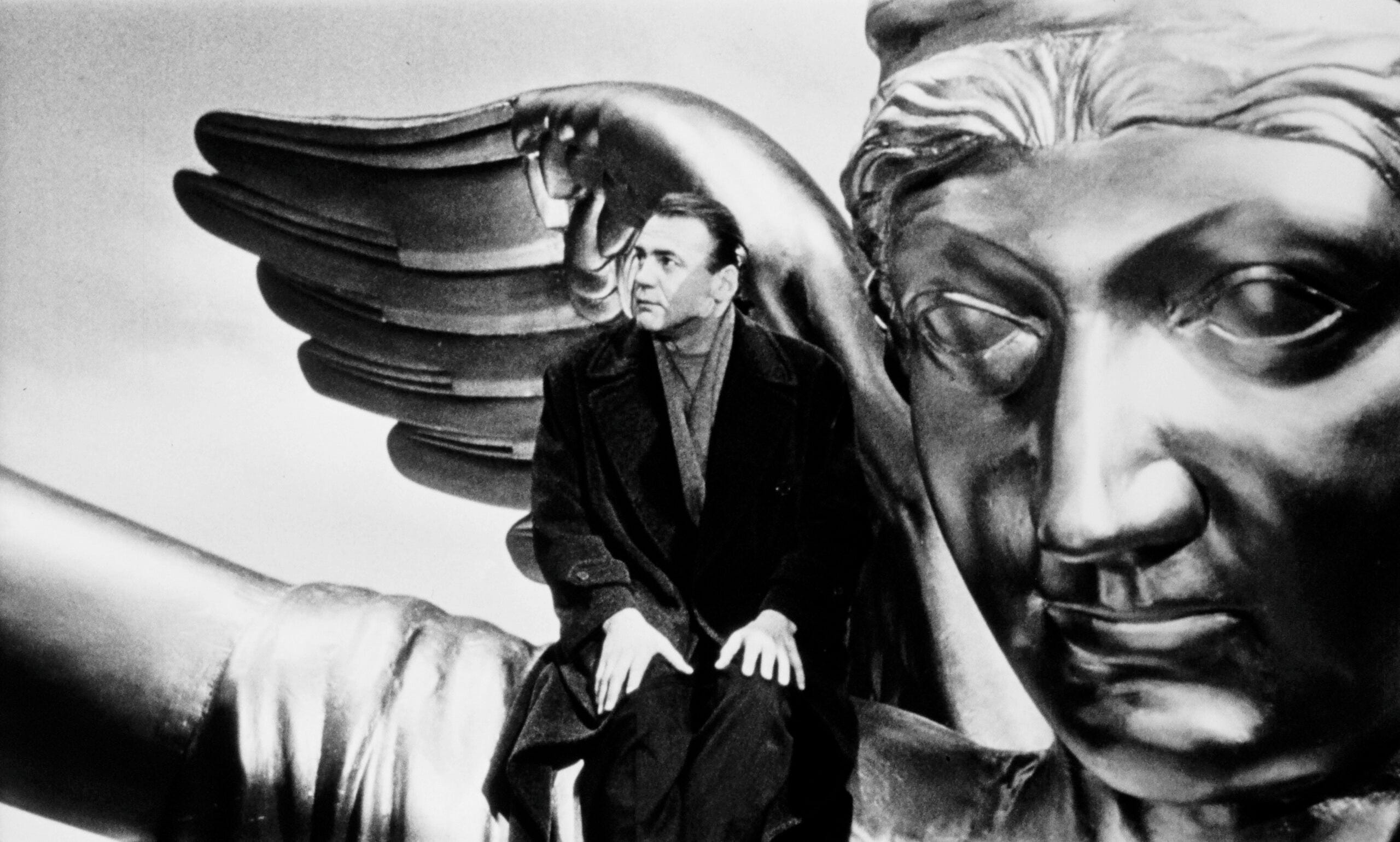
Wings of Desire (1987) dramatizes what it would be like to see the world with 20/20 sacramental vision, to experience continuously the kind of gratitude we celebrate on the fourth Thursday of November. Damiel, one of the film’s recording angels, wants to be human so that he can experience the small moments of physical divinity that we take for granted or even think of as hassles. In his conversation with fellow-angel Cassiel, he describes his yearning for what us earthbound travelers never consider:
DAMIEL: It’s great to live by the spirit, to testify day by day for eternity, only what’s spiritual in people’s minds. But sometimes I’m fed up with my spiritual existence. Instead of forever hovering above I’d like to feel a weight grow in me to end the infinity and to tie me to earth. I’d like, at each step, each gust of wind, to be able to say, “Now, now, and now” and no longer “Forever” and “For eternity.” To sit at an empty place at a card table and be greeted, even by a nod.
Every time we participated, it was a pretense. Wrestling with one, allowing a hip to be put out in pretense, catching a fish in pretense, in pretense sitting at tables, drinking and eating in pretense. Having lambs roasted and wine served in the tents out there in the desert, only in pretense. No, I don’t have to beget a child or plant a tree but it would be rather nice coming home after a long day to feed the cat, like Philip Marlowe, to have a fever and blackended fingers from the newspaper, to be excited not only by the mind but, at last, by a meal, by the line of a neck by an ear. To lie! Through one’s teeth. As you’re walking, to feel your bones moving along. At last to guess, instead of always knowing. To be able to say “Ah” and “Oh” and “Hey” instead of “Yea” and “Amen.”
CASSIEL: Yeah, to be able, once in a while, to enthuse for evil. To draw all the demons of the earth from passers-by and to chase them out into the world. To be a savage.
DAMIEL: Or at last to feel how it is to take off shoes under a table and wriggle your toes barefoot, like that.
He doesn’t want to wrestle with Jacob or dine with Abraham, which is only a “pretense” anyway, since an angel doesn’t need to eat. He wants to be a human that can experience actual meals and the goodness of the physical world, even if that goodness is out of the expected category: none of us would want a fever, but to Damiel a fever would be a new sensation. He may be romanticizing the nature of physical life just as we often do to the spiritual one: it’s like his own inversion of the gnostic heresy, which holds that the spiritual realm is completely good and the material world completely evil. Damiel doesn’t think in binaries or assume that there is no suffering in the material world. But after seeing Marion on the trapeze, he needs to experience life in her realm, just as humans yearn to one day experience life in Damiel’s.
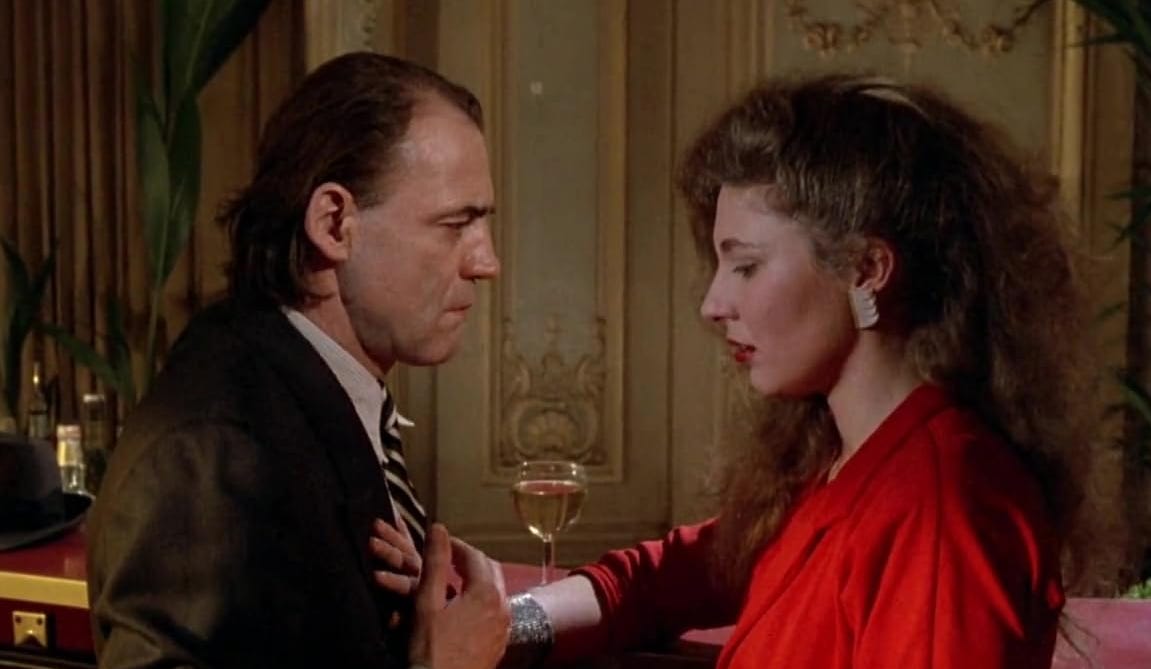
When Damiel becomes human, he states, “My amazement at man and woman has turned me into a human being.” That’s the key: he is filled with wonder at the physical world in a way that many of us no longer are. When was the last time you complained about the weather? Or a neighbor? We are not amazed by the miracle of other people. If we were, we could fly from the purgatorial grey of our Berlin into a richly-colored world. And the most satisfying way to show one is amazed by another person is to fall in love. Damiel learns what Paul McCartney meant in 1970.
Wings of Desire stays with the viewer; part of how it works is to flood the viewer’s mind with images that seem, at first, disconnected but which also take root and then resurface a day or week later when one isn’t suspecting to think about a trapeze artist or Peter Falk. More like a painting than a film, Wings of Desire flips the usual extolling of the spiritual world over the material one and asks what our lives could be like if we could see the material world through a new lens—both that of an angel and of Wim Wenders, whose camera gracefully floats the whole time. It’s a film universally loved for reasons that are difficult to articulate but certainly strong and the kind of film that becomes better the more you discuss it.
My first time through, I was unsure how to react and confess to a sneak or two at my watch. After we recorded our episode, I wanted to watch it again.
Listen or download the episode here, or wherever you get your podcasts: