

Three Cheers for the Conventional!
Blue Jasmine

There are movies we admire because they break all the rules. Kind Hearts and Coronets, Picnic at Hanging Rock, The Umbrellas of Cherbourg, or 2001 are in their own category because they flout conventions and still get away with artistic murder. Alec Guinness playing eight roles, a mystery without a solution, a love story in which every line of dialogue is sung, and a timeframe bookended by The Dawn of Man and Beyond the Infinite aren’t simply clever; they are examples of creators upending what already works in order to better suit their content. Even a recent favorite like the one-take Boiling Point breaks the now-conventional breaking of the rules by returning to Aristotelian unities of action, time, and place. As with the others mentioned here, it does so honorably, with a purpose other than being “edgy.”
Yet there is great pleasure in seeing a film that so perfectly demonstrates mastery of every aspect of filmmaking without stylistic innovations, daring maneuvers, or endings that inspire film students to create red-arrow videos. I’m talking about a film with a clear three-act structure, an interesting protagonist who desperately wants something they cannot have, a perfect cast from the lead to Subway Rider #2, costumes, scenic design, lighting, and sound, all of which work flawlessly and invisibly. Their perfection only becomes apparent when a viewer pauses to appreciate them; during the film, the viewer is too caught up in the narrative. The Apartment, His Girl Friday, and Stagecoach are all such films, ones that a Martian could reverse-engineer for the theaters of his home planet. Show that Martian Casablanca and he’ll be entertained; teach that Martian how Casablanca works and he’ll make films for a lifetime. The Criterion Collection is called “a film school in a box,” which points to the same idea that everything one needs to know about film can be found on the screen more than in a seminar.
These aforementioned films are conventional in the best sense of the word. Yet “conventional” has become a by-word for “unimaginative.” In Henry James’s The Portrait of a Lady (1881), the heroine Isabel Archer is shocked to learn that her husband, whom she admired as a man aloof from the petty demands of polite society, is as concerned about appearances and money as everyone else—even more so. “I’m convention itself,” he states, proud as a vegan. A search of the addictive Corpus of Contemporary American English reveals that “conventional” is used primarily to mean “predictable,” “unadventurous,” “unoriginal,” and “usual.” Osmond is supposed to be above concerns of wealth and class, but it turns out that he’s like the villain in The Incredibles, who proclaims, “I’m always beneath you, but nothing is beneath me!”
Artistic conventions have become conventions because they work. I am not anthropologically certain why our narrative structures and elements evolved as they have, besides assuming that they are indicative of our relationship with linear time. We perceive events as having beginnings, middles, and ends and this informs the way we tell stories; if we were all Dr. Manhattan or Tralfamadorians, our literature would read very differently. Yet these, like all conventions, are artificial: we don’t need to tell stories in paragraphs with occasional dialogue, just as we don’t need the physical shape of a book to be taller than it is wide. Narratives don’t exist in nature, outside of humankind. Ulysses has an entire chapter consisting of 309 catechistic questions and answers:
Why did Bloom refrain from stating that he had frequented the university of life?
Because of his fluctuating incertitude as to whether this observation had or had not been already made by him to Stephen or by Stephen to him.
What two temperaments did they individually represent?
The scientific. The artistic.
We could rewrite Daniel Defoe’s conventional Robinson Crusoe in the same style—
What were the reasons why Crusoe’s father urged him to not become a sailor?
Advocating “the middle station” of life, he urged his son to consider that a life at sea invited unnecessary risks to his person and his soul, since such a life would prove displeasing to God. He also used Crusoe’s older brother as an example of an unfortunate young man who sought adventure yet was killed in the Low Country wars.
How did Crusoe receive this advice?
Initially, with obedience; after almost a year, as mere words easily ignored.
—but doing so wouldn’t serve any artistic purpose. The point is that conventions aren’t something to surmount; there’s a difference between the trite and the conventional. There’s great pleasure in reading Ulysses, but there’s just as much to be found in Robinson Crusoe. The former upends what the latter has established, but that doesn’t make it more “artistic.” (For the record, Crusoe was one of Joyce’s favorite novels and he was a tough man to please.)
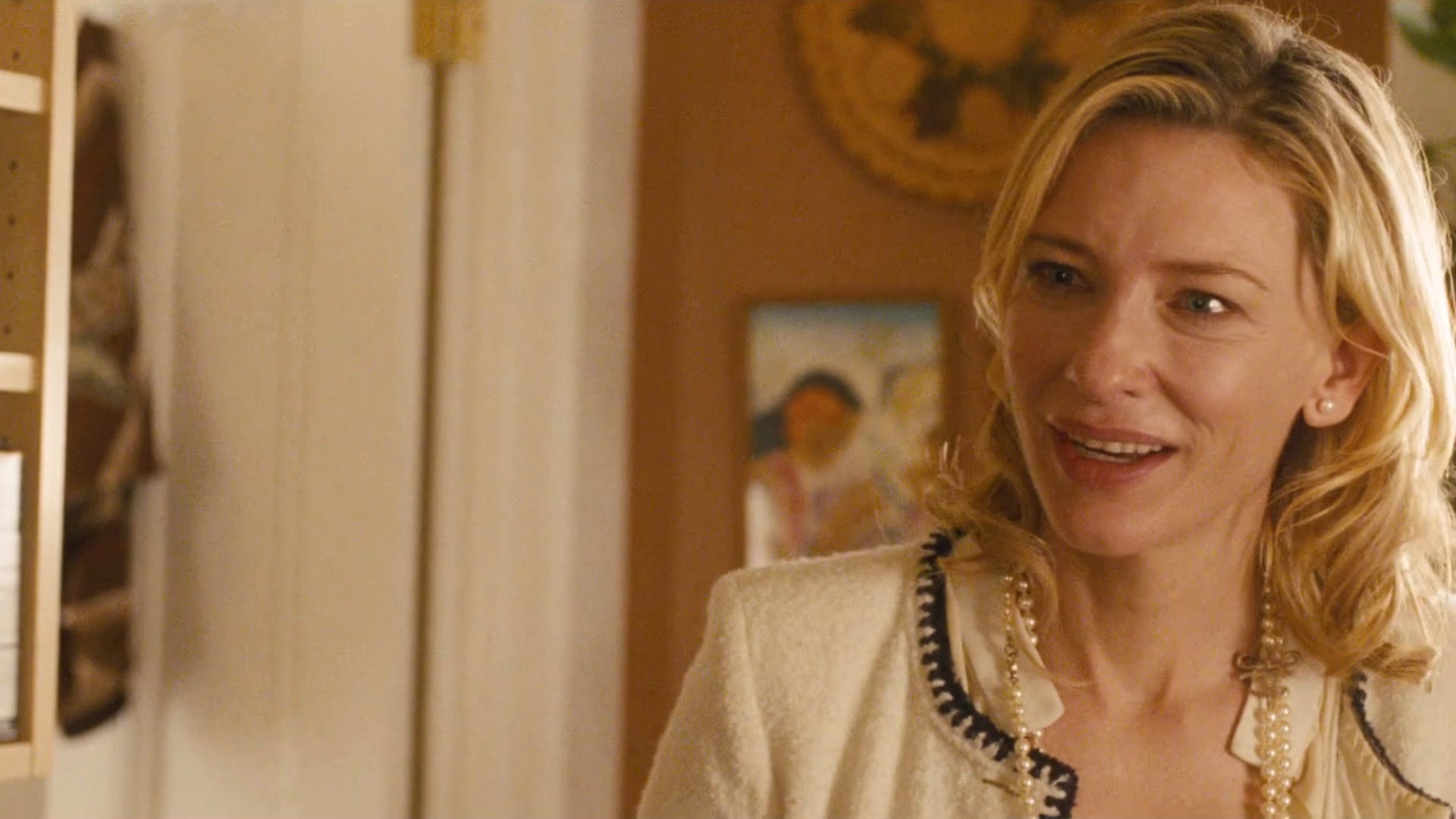
To that list of films that use cinematic and narrative conventions so well that the aforementioned Martian could learn all of them, one needs to add Blue Jasmine. Woody Allen’s 2013 film is his 44th and one of the the best of the subgenre Woody Allen Movies Without Woody Allen. Every frame of it is perfect; every line hits; every image brings the viewer further into its world; there isn’t an extraneous moment or unclear motivation. Blue Jasmine doesn’t have a moment as striking as Jeff Daniels walking off the screen in The Purple Rose of Cairo or the wonderful sound mix and grainy film reels of Zelig, but it’s just as impressive. It’s an honest film that never winks at the viewer and reminds us that conventions exist because when they are followed they work so well. If Nicholas Cage in Adaptation had seen this, he may have been able to turn The Orchid Thief into a screenplay without getting berated by Brian Cox.
The most obvious convention that Blue Jasmine exhibits is a plot featuring a protagonist who wants something and is thwarted in her desire to get it. In Aspects of the Novel, E. M. Forster says, “‘The king died, and then the queen died’ is a story. But ‘The king died, and then the queen died of grief’ is a plot.” A story is a series of events. A plot is a sequence (“and then”) of events (“the queen died”) colored by explanations (“of grief”). In the story of King Lear, we don’t know why he dies; in the plot, we do. In Blue Jasmine, the plot complements the story so perfectly that the viewer is never in doubt as to why the queen is becoming unraveled. The viewer doesn’t know the plot all at once; Forster notes that “The queen died, no one knew why, until it was discovered that it was through grief at the death of the king” is also a plot, this time “with a mystery in it.” Blue Jasmine works by having the former socialite Jasmine move through a series of events while living with her sister (story) and us understanding her reactions (plot): she’s a fish out of water. But we also get the mystery element of learning why Jasmine has come to her sister in the first place. The revelation isn’t a slap in the face or debatable incident about which viewers can bicker; it’s an event that fully colors the incidents we’ve seen without irony or us having to rewatch the whole thing like a murder mystery. The forward motion and flashbacks are seamless and each timeline informs the other, which makes me reluctant to even use the word “flashbacks” when describing the action. To Jasmine, like Hamlet, the time is out of joint.
A second convention is its perfect three-act structure. You could set a bell to ring every thirty minutes and Blue Jasmine would conclude each act as soon as you heard the sound. The timing would be more impressive and exact than what happens when people play The Dark Side of the Moon and watch The Wizard of Oz. Almost all of Allen’s movies are plus-or-minus ninety minutes for good reason: there is something seemingly natural about that artificial structure.
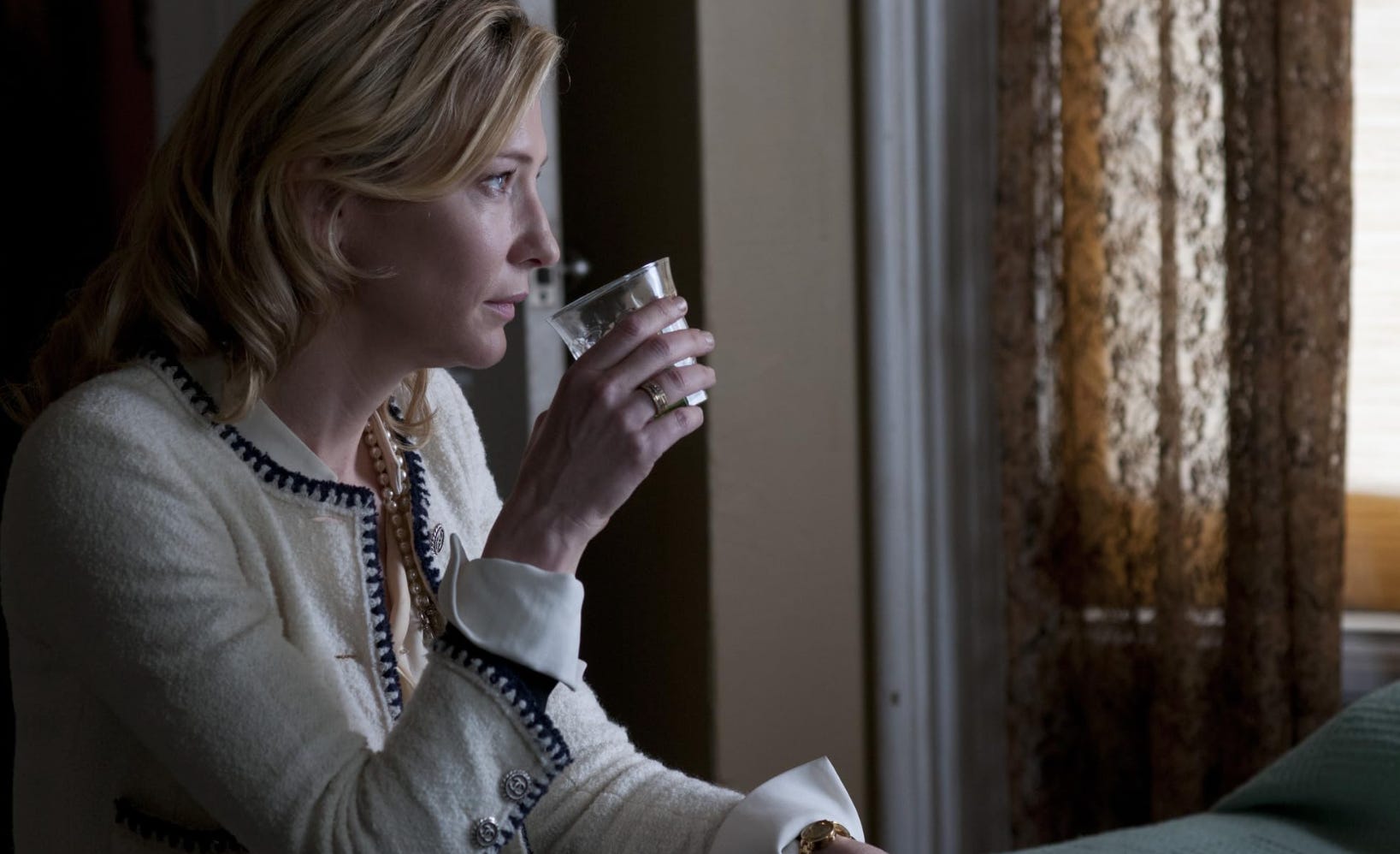
We also get in the film a master class in how costumes reveal character. We’ve heard vestis virum facit, that clothes make the man, and here the clothes don’t simply complete the characters; thanks to the work of Suzy Benzinger, they perfectly reflect their values and assumptions. A film about a socialite had better convince us that she is one, and everything Cate Blanchett wears looks exactly like what Jasmine would choose: expensive, not gaudy. Her watch, earrings, luggage, and handbag all mark her as someone who doesn’t know the price of things and has never had to ask. But it’s not only her: her working-class sister, Ginger, sports a T-shirt with a tiger that doesn’t reveal any kind of animal ferocity—it’s the kind of shirt that she would think was cool. Everything looks like the characters wore them to the set.
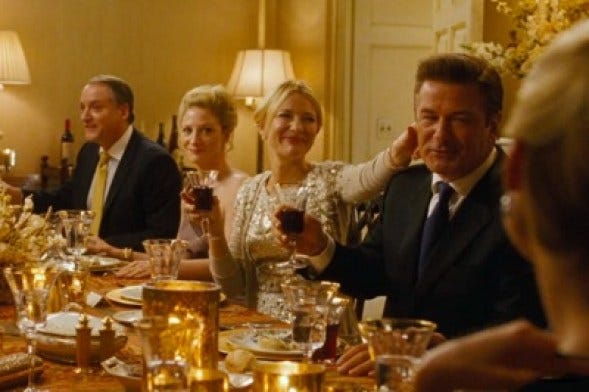
And what sets! There’s a scene early in the film in which Jasmine and her husband are at a dinner party and the frame has as much gold as their portfolios. As with the costumes, the sets aren’t simply “expensive looking.” They reflect Jasmine’s view of the world and her place in it; she walks through them without seeing them. Only we—and, by extension, her lowbrow sister—are impressed.
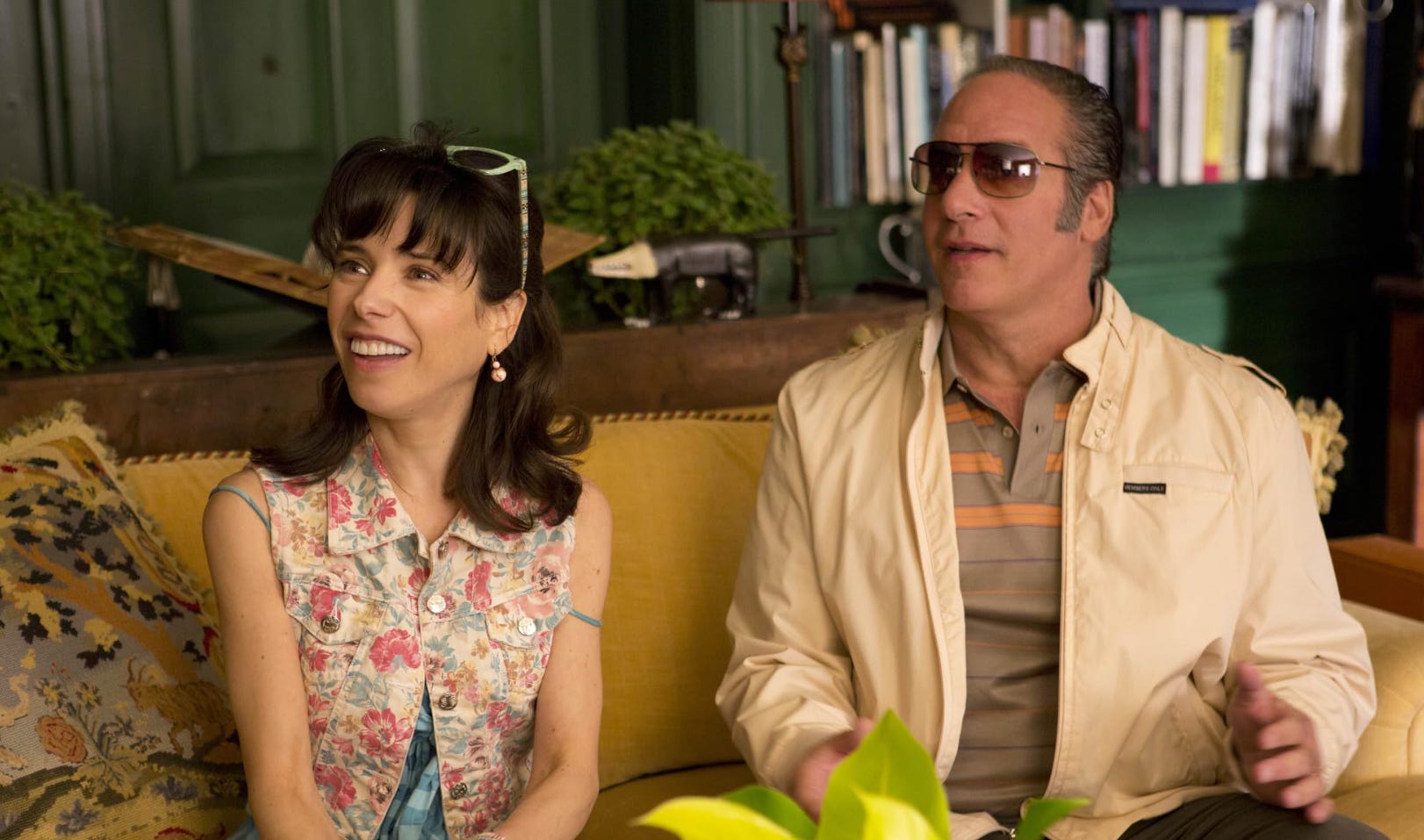
I could go on. The soundtrack (made up mostly of Allen’s usual jazz standards) that echoes the action and, in the title’s spin on “Blue Moon,” summarizes what’s happened to Jasmine; a great supporting cast including Sally Hawkins as Jasmine’s sister, Alec Baldwin who channels for a full movie the ethos of his ten-minute monologue in Glengarry Glen Ross, Louis C.K. (unbelievably), and (even more unbelievably) Andrew Dice Clay, looking and talking exactly as they should; and, of course, Cate Blanchett in a performance as all-in as DeNiro’s in Raging Bull. (Watch what she does when she’s not speaking and try to find a crack that lets in the light of the actor. It’s impossible.)
I haven’t said anything about the film’s themes or how it’s a reimagining of what Allen regards as the greatest American film. All of that is better experienced without any setup. The film and the conventions that sustain it will do all of the work.
Elsewhere in Aspects of the Novel, Forster reiterates the difference between a story and a plot by explaining:
If it is in a story we say “and then?” If it is in a plot we ask “why?” That is the fundamental difference between these two aspects of the novel. A plot cannot be told to a gaping audience of cave men or to a tyrannical sultan or to their modern descendant, the movie-public.
Perhaps in 1927, the year of Forster’s book, the “movie-public” was only concerned with stories and only wanted to ask, “And then?” But in the last ninety-nine years, we have evolved to the point where we have a set of conventions early filmmakers established through trial-and-error. Blue Jasmine succeeds so well because it follows every rule.
You can find this week’s episode of Fifteen-Minute Film Fanatics in which we discuss Blue Jasmine wherever you get podcasts. Please subscribe to the show and consider leaving a review on Apple Podcasts or Spotify.
Another great read. A line that stood out to me was: "Yet conventional has become a by-word for unimaginative." I liked the multiple movies mentioned, especially a Dan Moran classic- The Purple Rose of Cairo.
I enjoyed reading this. Haha…”proud as a vegan.”