

They Ain't Human
The Perfection of His Girl Friday

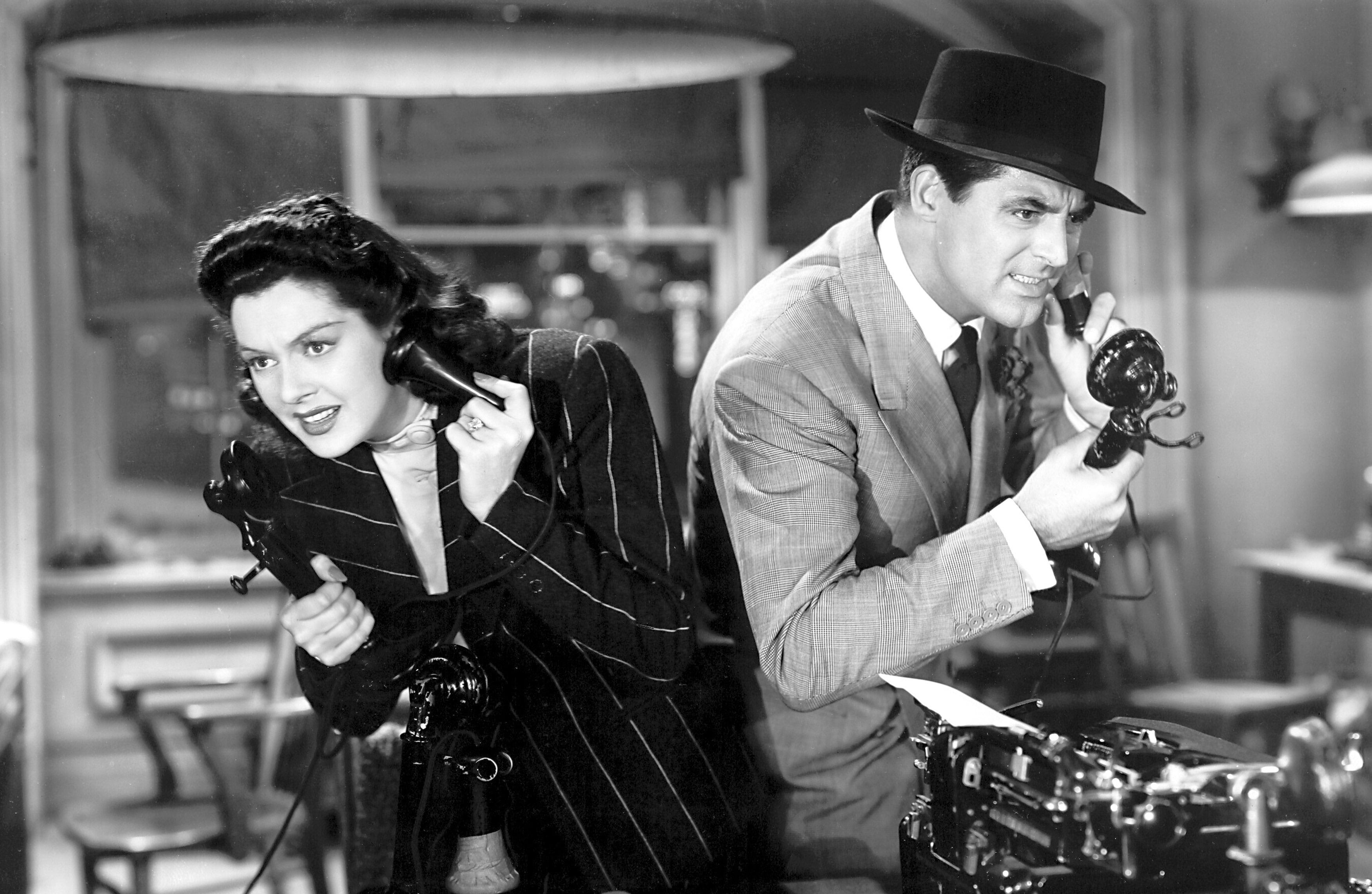
Trying to write about what makes His Girl Friday so great is like trying to describe the face of a beautiful woman. It’s a movie that we on FMFF have avoided discussing on purpose because we weren’t sure what we would say besides, “That’s another great thing about it … As is that … And that …” We’d be reduced to Chris Farley interviewing Paul McCartney. A film as perfect as this almost defies criticism: where does one begin? But after more than three-hundred episodes, we’re finally ready.
To open his BFI book on The Big Sleep (another Hawks masterpiece), lovable grouch David Thomson does what no parent or movie lover is supposed to do: he names, with the smallest of caveats, a favorite:
For decades now, since a Saturday in 1961 when I saw it three times in a row, coming out of one screening at the National Film Theatre’s original Hawks season and joining the queue for the next (as if the movie were a ride on a sensational fairground entertainment), I’ve regarded Howard Hawks’ The Big Sleep as my favorite film. Or, if not quite that, then the most entertaining, the most rich, confident and comfortable. It’s a picture you want to curl up in, like Bogart and Bacall in their tiny car, just looking at each other and practicing kissing, while music and fate build up outside like a thunderstorm. It has always seemed to me, somehow, the happiest of films, so relaxed and yet so controlled: seeing it offers the chance of a rapture like that of being in love.
That’s how I feel about His Girl Friday, which is supremely “confident and comfortable” and very much like the “fairground entertainment” mentioned above. The last time it played in our local revival house, I saw it on a Friday night and then again the next afternoon, justifying the expense of money and time on the grounds that it was an all-time favorite on the big screen—and, at 90 minutes, it would take less time to watch it again than it would on a regular day to get up, get ready for work, and drive to the office. And who wouldn’t want to spend another ninety minutes at the Morning Post?
Everyone loves the speed of the film. Hawks set out to direct a movie with the fastest dialogue of all time and succeeded; the conventional wisdom is that actors in films speak about 90 words a minute, but in His Girl Friday, Hawks got them up to 240. All of that speed perfectly suits the news business, where as soon as something is printed (or posted) it begins to lose its value; if the film were about shoemakers or lighthouse keepers, the pace wouldn’t fit. Cary Grant and Rosalind Russell are able to keep up the pace with each other and on multiple telephones so effortlessly that the only proper reaction is awe. As Molly Malloy later says, “They ain’t human”: they are true movie creations, moving and talking and looking like they only exist on celluloid—because they do. Nobody you know looks, talks, or carries himself like Cary Grant; nobody you know has comebacks as fast as Rosalind Russell’s. They are as movie-bound as King Kong.1
What’s easy to miss the first time around is the absence of any score: the only music we hear is in the opening credits and then at the very end. Yet the film is as close to a musical as it can be without crossing the literal line. The characters sing the whole time in arias and duets; the reporters in the press room are a chorus. In The Umbrellas of Cherbourg, the characters sing because their heightened emotions cannot be conveyed in mere words; in His Girl Friday, mere words are elevated to something like music. Finishing this film and then immediately beginning another is like moving from the blank verse of Shakespeare to the declarative sentences of a commercial for laundry detergent.
Hildy Johnson’s fantasy is that she can do a victory lap, say goodbye to her job, and have everyone there affirm the rightness of her decision. Like Coriolanus, she asserts that there is a world elsewhere—and, again like Shakespeare’s hero, she finds out she was wrong. She can leave the job but the job won’t leave her and we know after a few seconds with Walter Burns that the film will be the story of her coming around to what we already know. Walter—or, more accurately, Cary Grant, for only he could have his onscreen persona fill the vacuum of “Walter Burns” so smoothly, making it impossible to refer to him in this film as anything other than “Cary Grant”—is the personification of what she is trying to avoid: a world of constant motion, of spending honeymoons covering strikes, of living to work instead of working to live. Yet he’s handsome, charming, smart, and funny. Who could stand a chance against him? She was born to this and is great at it—Walter tells her, “Nobody at this paper can write!”—and he doesn’t want her to throw away that one talent, which is death to hide.
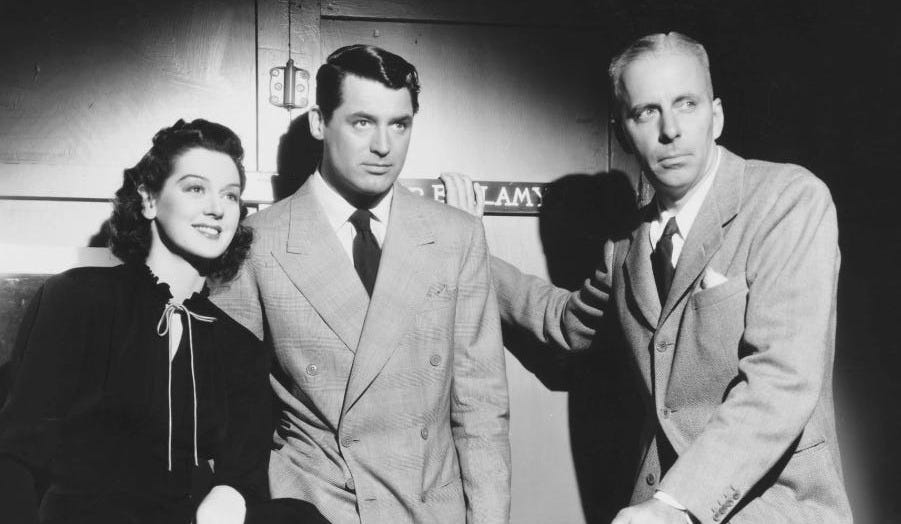
This is why the phrase “production for use” is so suitable. The film’s condemned man, the hapless Earl Williams, is being hung for shooting a cop and says that he heard this phrase—the idea that “everything that is made should have a purpose”—spoken by some Bolshevik in the park before he pulled the trigger. Hildy spins this for Williams’s defense: since the purpose of a gun is to shoot, Williams wasn’t wholly responsible for his actions. He was under the influence of the phrase! He simply used the gun for its purpose! As a piece of psychology or legal maneuver, this is sad stuff, yet nobody at the Morning Post or Howard Hawks really cares. It’s a way to get that phrase into the viewer’s ears, since the movie is about Hildy denying her production for use and then getting another chance.
The only time the pace slows (and Cary Grant is offscreen) is when Mollie Malloy (Helen Mack), the simple soul sympathizing with the condemned Earl Williams, breaks into the press room and delivers her nest of vipers speech as the reporters continually mock her naiveté:
When Mollie says, “They ain’t human” and Hildy responds, “I know, they’re newspaper men,” this isn’t a joke at which we’re meant to laugh. As Mollie leaves and cries, “All they’ve been doing is lying … All they’ve been doing is writing lies … Why won’t they listen to me” we get the film’s first pause at the 38-minute mark. Even reporters have consciences that are aired out once in a while. This moment calls out what we would today call “fake news” and it works like a miniature version of Absence of Malice or Network in the middle of the comedy. Like Viola Davis in Doubt, Alec Baldwin in Glengarry Glen Ross, or John Candy in Home Alone, Helen Mack has one scene and nails it. Her exit leaves a ripple effect over the next few moments, until Bruce phones Hildy to explain he’s been arrested and she runs from the room, almost flattening Sheriff Hartwell (Gene Lockhart) in the process. If this scene came near the end of the film, it would provoke an eye roll; placed at the end of the first act, it’s a way for Hawks to signal that there’s some trace of humanity among these people, albeit one that Mollie never gets to see.
Is there another film so deeply cynical and yet so exuberant and joyful? Is there another in which the viewer is reminded every second that they are watching something so clearly “performed” and yet so engaging? Is there another as on-point about its subject yet with so little of an axe to grind?
And now that it’s in the public domain, anyone can watch it for free at any time.
I’ll see you in ninety minutes.
This essay accompanies this week’s episode of Fifteen-Minute Film Fanatics, a podcast that always breaks the premise of its title but never wastes the listener’s time. The post and the podcast complement each other; the post isn’t a summary of the podcast, so please give it a listen. We take requests; leave a comment below if there’s a film you’d like us to cover. We’ve done over three hundred episodes that you can find on Spotify, Apple, or wherever you get your podcasts. There’s also a player at the end of this post. Check out the back catalogue for episodes on your favorite films. It’s free everywhere, fueled by enthusiasm. Thanks.
We may know people like them: I’m reading Ben Hecht’s memoirs now and it’s easy to see him in all of the characters; he was a scrambling, smart, sarcastic Chicago reporter before he co-wrote The Front Page, the play (and film) upon which His Girl Friday is based. But you’re never going to meet Walter or Hildy anywhere other than this movie.
Hawks had such incredible range. Not an original observation but every once in a while I remember again.
Hecht's A Child of the Century is a great companion piece to His Girl Friday, also my favorite film. But I never understood the movie's title.