

Beat the Devil
Reading The Exorcist as a Kid

For Sherman Alexie
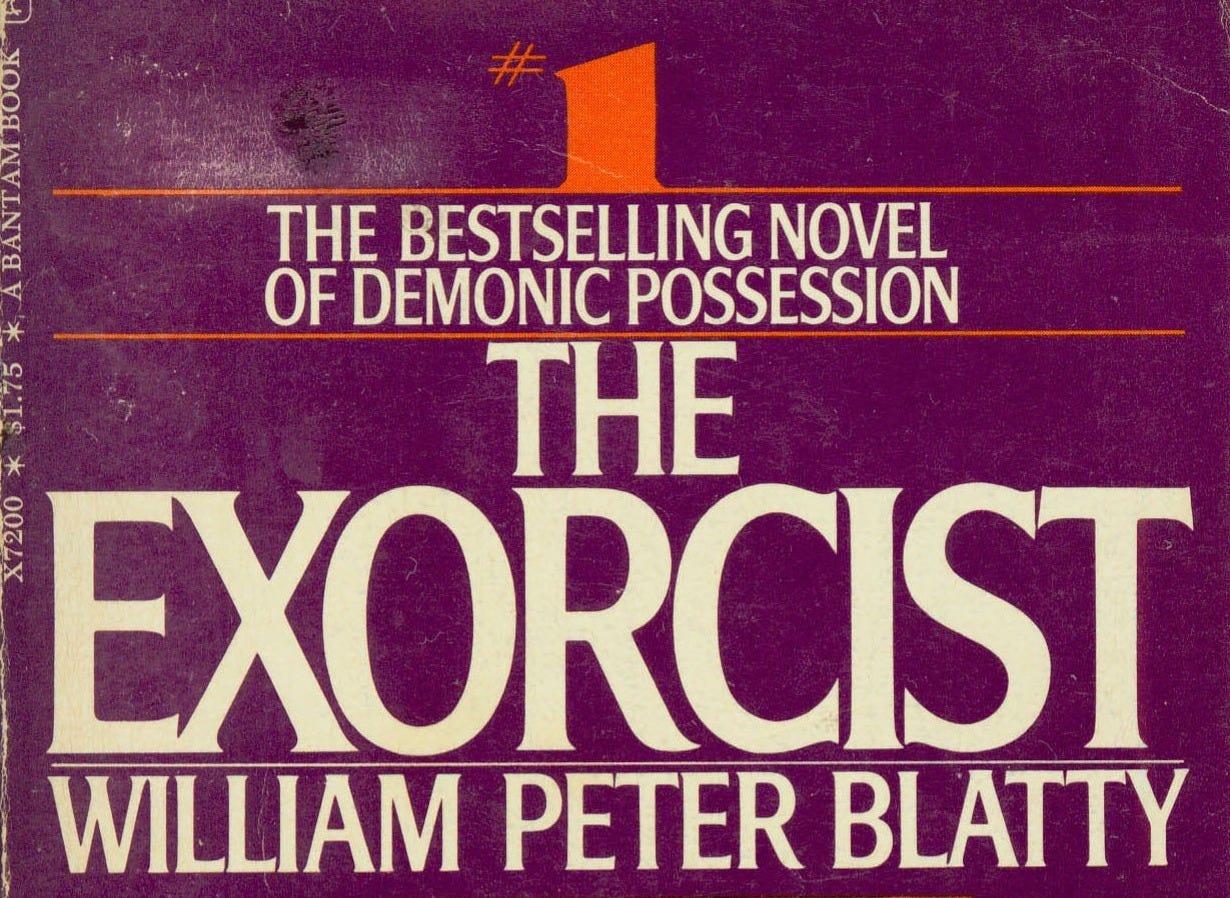
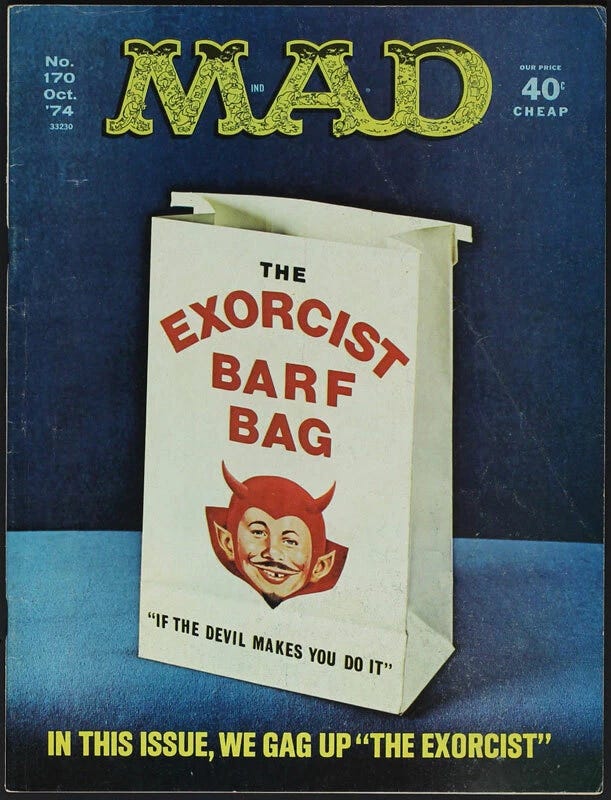
I was five years old when The Exorcist premiered on the day after Christmas in 1973. Of course, I wasn’t aware of it at the time, but growing up in the 70s meant that this movie was always there. It was the punchline of jokes on Bob Hope specials, parodied in MAD magazine, and such a constant feature of popular culture to the extent that even if you hadn’t seen it, you knew two things for sure: there was a scene where the girl’s head spun around and there was a lot of vomiting. News reports showed lines of ticket buyers waiting to get in and then footage of people passing out, in tears, and running from the theater. With the internet and streaming services designed to give us all what we want the second we want it, young people today cannot wholly appreciate the notion of a shared culture, but everyone in the mid-70s shared some knowledge of The Exorcist, just as Warner Brothers had hoped.
By the time we all reached sixth grade, seeing it was the movie equivalent of kissing a girl: something fascinating that older, cooler kids had done and which remained shrouded in mystery. It was forbidden fruit: someone at recess would tell everyone, “My cousin saw it” and then narrate scenes from the film and others that were probably invented there on the blacktop. (“So there’s this part where the priest, like, grows these sort of wings and flies around the room and fights another guy.”) By the time I reached middle school, I had watched thousands of hours of movies on TV; they were my after school and weekend companions. But this was still before the time of VCRs, so The Exorcist remained the ghost orchid of my watchlist. I loved horror movies and this seemed like the next step after some of the ones all I watched while chomping Cocoa Pebbles on Saturday mornings. Granted, those were movies like The Blob and other clunkers, but I didn’t care about quality.
And then, in 1980, I was given the chance to test my mettle when CBS announced that it would show The Exorcist on network TV. Of course, the warnings about its heavily-edited content only enticed me more: “Viewer discretion advised” was like catnip. (This is another cultural feature that young people today cannot understand, since a toddler can basically click on Caligula as easily as Cars.) When I asked my father—the Changer of the Channels—if I could watch it in the living room, he said sure.
This may strike readers as terrible parenting, but this is something for which I’ll always be grateful: they let me watch basically anything.1 A year before these events, my dad took me to see Alien, the logic being that I liked Star Wars so much and, well, this is basically another space movie, right? And a year before Alien, we went to see Magic, in which Anthony Hopkins plays a schizophrenic ventriloquist with a dummy that had terrified people who saw only the trailers. In 1983, my mother took me to see the remake of Scarface, which was all over the news (and, again, popular culture) for using the F-word as much as it did. They let me watch Chinatown and Godfather II on HBO; I couldn’t follow what was happening, but knew that these were movies in the locked liquor cabinet and that they didn’t care if I took a sip. In our moment of overprotective parents and trigger warnings, parents worry about their kids seeing anything more disturbing than Bluey (while simultaneously handing them iPads and the whole wide internet at birth). But letting me see One Flew Over the Cuckoo’s Nest on cable—regardless of my inability to understand how the hospital was a metaphor and all the other elements that are obvious to adult—they at least exposed me to real drama. I still watched Gilligan’s Island but also got to see Patton and Butch Cassidy and the Sundance Kid.
So there I was on February 12, 1980, in the living room with my dad. (My mother wanted no part of this: she didn’t know much about movies, but she knew enough.) The warnings began and I felt like I was forty instead of twelve. I was ready for the devil, but saw instead Father Merrin doing archeological work in Iraq. Where was the girl? Where was the girl with the spinning head who said all the curses? I sat quietly and watched him unearth the trinket, almost get run over by the coach driven by an eyeless driver, and stand looking at the demonic statue while the fighting dogs took over the soundtrack. This is the big scary movie? I felt like the knight in Monty Python and the Holy Grail who complains, “I almost shit my armor for this!” when he sees the killer rabbit.
I grew more cocky by the minute. Young Regan MacNeil with her Ouija board and then complaining that her bed was shaking were mildly spooky, but her mother on the movie set and Father Karras’s crisis of faith suggested to me that so much of the movie had already happened and that soon Regan’s head would spin and that would be it. The adult characters talked; Reagan had her EKG. But when we reached the scene where the priest sees the defiled statue of the Virgin Mary, which is also weeping blood, I froze. I had been an altar boy for years. This was bad—but the moment was over in a second, followed by a commercial break, so I was able to reset. My father, meanwhile, didn’t say anything. We may as well have been watching the zoning board.
After the commercials, we finally reached what everyone expects: the full-on scenes of possession, heralded by Lynda Blair doing a kind of horrific set of sit-ups on her bed before director William Friedkin fills the frame with her face, her eyes roll back in her head, and she speaks in the demonic voice that Mercedes McCambridge achieved by being tied to a chair, chain smoking, and drinking whisky.
Check, please!
I ran from the living room faster than I have run anywhere since. Decades later, when my six-year-old son ran from the room when he first saw the Gorn on Star Trek, I thought of this very moment. I was terrified, almost in tears, and—like all good parents of that generation, mine scolded me: “What did you watch it for? I told you it would be too scary! That’s what you get!” Today, parents would sue the network; then, my parents told me that if the movie I insisted on watching was going to make me cry, they’d give me something to cry about. I don’t remember if my dad finished it. I was having a breakdown like Blanche DuBois.
The next day at school, we all talked about it and whose parents let them watch it. I assume now that many of us were lying; I know I was. I said something like, “It was really good” and changed the subject. Nobody knew and my parents never added it to the family lore, but the shame haunted me almost as much as the demon. I couldn’t believe I ran from the room! What a baby! Afraid of a movie? Really?
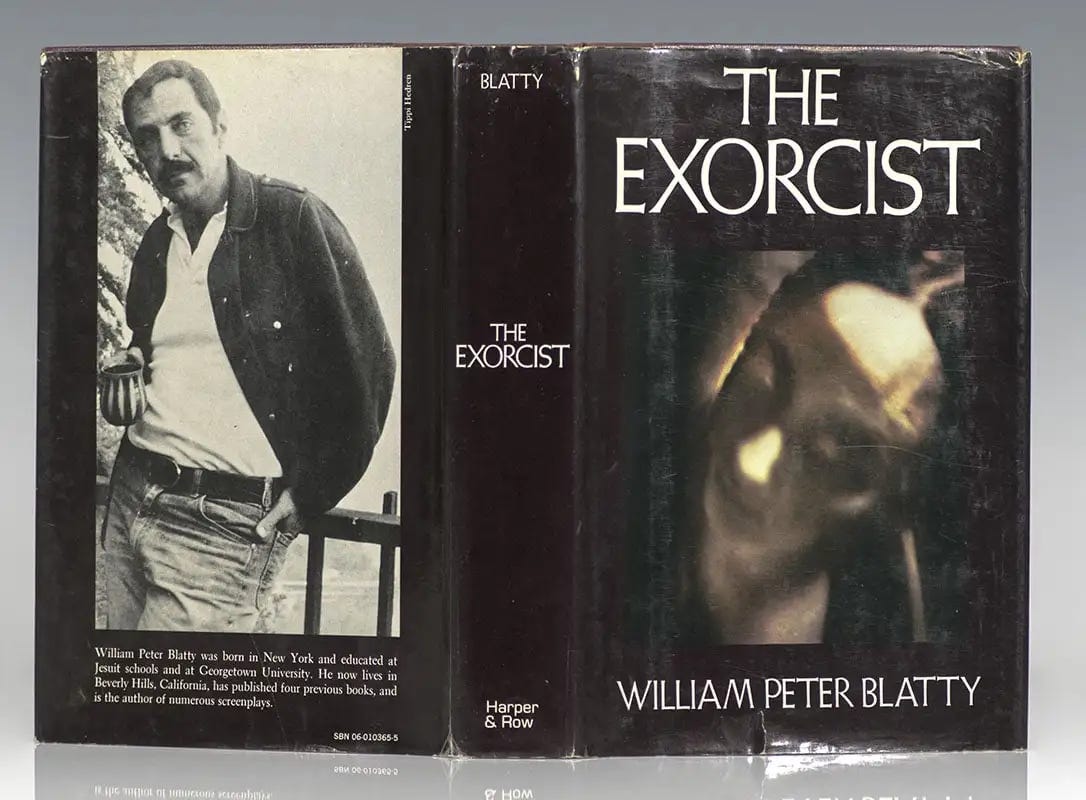
A few weeks later, I was at the library, to which my mother took me every Saturday. The place had a strict no-noise policy that I miss so much in libraries today. There was a kids’ section but no “Teen Center” or space for a tween like twelve-year-old me and the adult section was a no-go zone. There were even signs. I used to check out books about dinosaurs, space travel, and anthologies with Alfred Hitchcock’s face on them. It occurred to me that they might have the book of The Exorcist, since every ad said it was “based upon the bestselling novel.” I looked in the card catalogue (paper cards, not a keyboard) and found it was located in “ADLT FIC BLATTY.” I casually strolled into the adult section thinking I was like James Bond but more like Don Knotts, and saw it, there on the shelf. I looked over my shoulder—my mother was nowhere in sight—and grabbed it. The laminated cover simply showed a girl’s blurry face; the back showed the author leaning against a railing and holding a cup of coffee. How scary can this be? The guy is drinking coffee–and coffee is not scary. I wanted to read it, to attempt another match with the story, to show that I could take it. I had to regain my self-respect.
I still had the problem of getting the book out of the library and was as nervous as Dustin Hoffman in The Graduate when he has to book a hotel room for him and Mrs. Robinson. I placed the book in the middle of my Saturday stack, between books like 1001 Jokes for All Occasions and Mars: The Red Planet. I walked up to the checkout desk (again, no self-serve computers) and handed my library card like a fake ID to the woman who had no idea of what was at stake. These were days when librarians would pull a ticket from the back of the book and place it into a machine that stamped, with ink, the due date and your library card number. Kids couldn’t get books from the adult section. What if an alarm went off when she checked it out? What if she told someone else there and they took away my library card? I was almost as afraid of the librarian as I was of the movie.
For whatever reason, she didn’t stop me. She was probably bored or distracted and uninterested in what this precocious young man would be reading. Maybe she missed the title. Within a few seconds, she handed me the stack of books and I walked away to find my mother for the ride home, during which I had the same emotions I imagined as someone smuggling drugs on a plane. I just hoped I wasn’t going to be in Midnight Express (which I had watched on cable at my cousin’s house). I didn’t think she would care that I was reading it, since when I was reading, I was quiet.
I found the book terrifying, but at least I was in charge of all the images that came into my head. I read it in two, maybe three sittings. I heard noises at night and stared at the ceiling, but there was no way I was quitting. And when I finished it, I casually mentioned it in every conversation for a month. “Yeah, the movie was pretty good, but the book—well, the book was really good.” “Oh, The Exorcist? Well, no, I haven’t seen the movie, but let me tell you about the book.” Finishing the novel gave me the justification to lie about finishing the movie. Of course, there was much in it that went over my head, such as the jabs at contemporary pediatrics (Regan’s doctor wants to fill her with Ritalin), the portrait of Regan’s single mom trying to balance motherhood and career, and the Stephen Dedalus-like guilt of Father Karras over his dead mother.
There were also the epigraphs. The first one made sense:
Now when [Jesus] stepped ashore, there met him a certain man who for a long time was possessed by a devil ... Many times it had laid hold of him and he was bound with chains ... but he would break the bonds asunder ... And Jesus asked him, saying, “What is thy name?” And he said, “Legion.” —Luke 8:27
But the second puzzled me:
James Torello: Jackson was hung up on that meat hook. He was so heavy he bent it. He was on that thing three days before he croaked.
Frank Buccieri (giggling): Jackie, you shoulda seen the guy. Like an elephant, he was, and when Jimmy hit him with that electric prod...
Torello (excitedly): He was floppin’ around on that hook, Jackie. We tossed water on him to give the prod a better charge, and he’s screamin’...
—Excerpt from FBI wiretap of Cosa Nostra telephone conversation relating to murder of William Jackson
What was “Cosa Nostra?” Were these guys going to be in the book? The third was equally confusing:
There’s no other explanation for some of the things the Communists did. Like the priest who had eight nails driven into his skull ... And there were seven little boys and their teacher. They were praying the Our Father when soldiers came upon them. One soldier whipped out his bayonet and sliced off the teacher’s tongue. The other took chopsticks and drove them into the ears of the seven little boys. How do you treat cases like that? —Dr. Tom Dooley
Who was Tom Dooley? I had a record about Tom Dooley hanging his head to cry, but this couldn’t be the same person. And while the image of the eight nails was disturbing, I was again unsure how this related to the girl on the shaking bed. Finally, there were three words, each alone on the page and without definition or comment:
Dachau
Auschwitz
Buchenwald
Of course, adults could see the meaning of these three words and their connection to Dr. Dooley, La Cosa Nostra, and Luke’s Gospel; if anything, today the page of epigraphs seems heavy-handed. But at the time, these were indicators that I was entering something above my head, the same way that the plot of Chinatown was: I didn’t understand how the girl in that movie could be both sister and daughter, but I knew that something there was terribly wrong. And each time I opened the book, I felt the thrill of a true bestseller: not the chill of great literature, but an almost visceral reaction to the words on a page. If other books in the adult section were like this, I was ready for my life as a library criminal.
I eventually saw the whole movie a few years later, in the dawn of VCRs, and made it to the end. Since then, I’ve probably seen it only once or twice, which is plenty. A few years ago, I laughed at a terrific moment in The Friedkin Connection in which the director makes his case that what remains possibly the scariest film of all time was never intended as such:
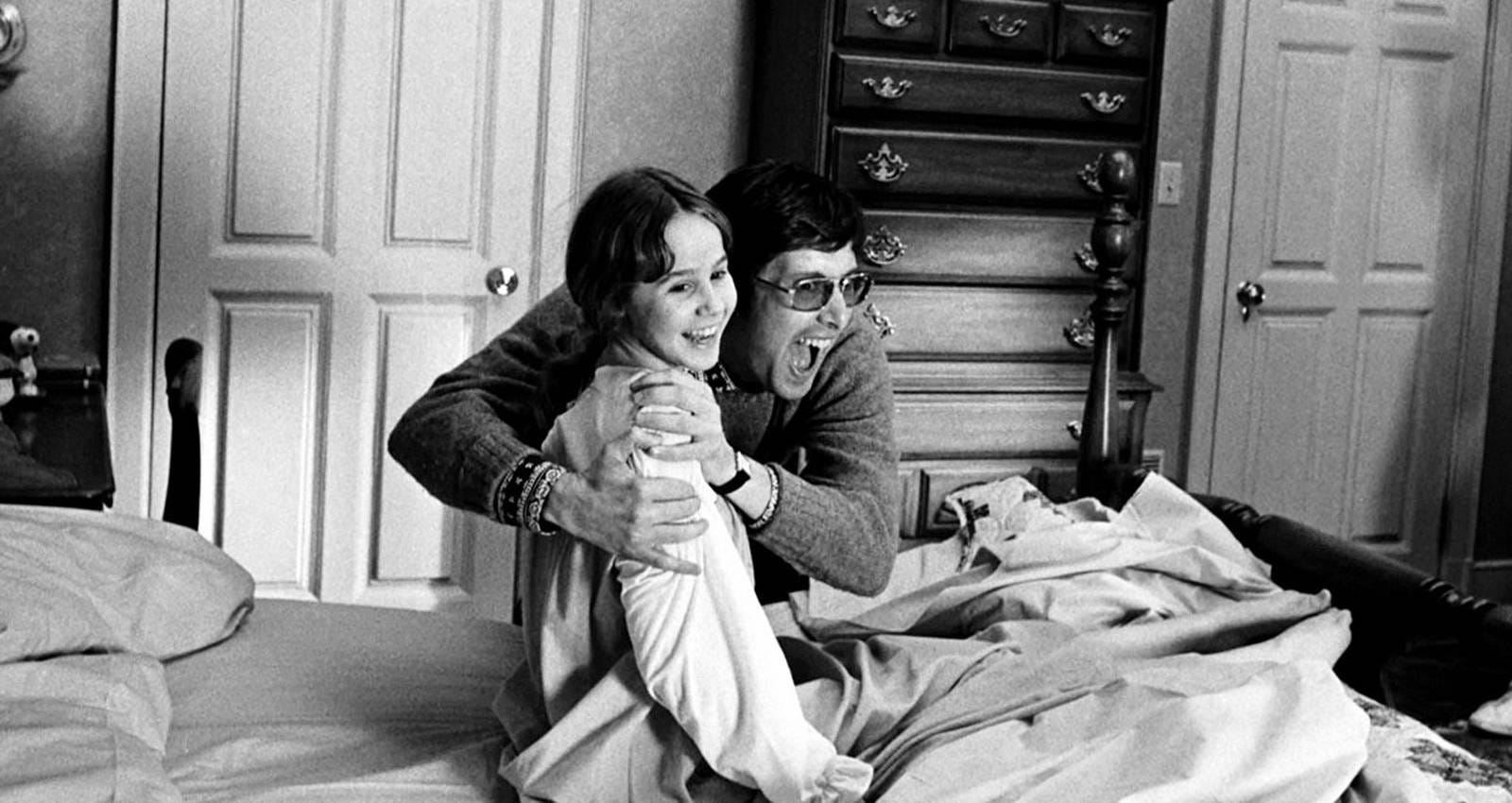
[William Peter Blatty and me] both shared the notion that The Exorcist was not going to be a horror film or a sendup but was going to be a film about the mystery of faith and the existence of good and evil in everyone. We never talked about this horror effect or that one. Having read a great deal of information about an actual exorcism case in 1949, I was convinced that what was claimed to have happened did actually happen. It was inexplicable in any other way as a case of demonic possession and exorcism. The ’49 case was extremely well documented. So I set out to make the film more along the lines of a documentary, not a horror film. Over the years, I understand that people consider it a horror film, and that’s where it lives in the public consciousness. But it has never been that to Blatty or myself.
This is like the producers of Debbie Does Dallas claiming that they were solely interested in dramatizing the ups and downs of modern romantic life; Friedkin is a great director but a bad liar. Fine: The Exorcist is “about the mystery of faith and the existence of good and evil,” but it’s not Winter Light. Great care was taken to terrify the audience to the extent that even an edited version on TV made at least one person nearly black out. But this is beside the point: I’m glad that Friedkin scared me enough to lead me to the novel, which taught me a never-forgotten lesson about the exhilaration one could feel while reading. As an adult, I can’t relive those hours: I know too much and think about language in a more complex way than I did as a kid. That’s all to the good; I wouldn’t want my twelve-year-old self to dictate what I read today.
But reading a contraband novel when one is the perfect age for all of its manipulations and over-the-top everything is a great way to become a lifelong reader— one almost possessed by language. If William Peter Blatty (like his co-conspirator Peter Benchley) led me to Joyce, Shakespeare, and Henry James, I’m eternally grateful.
Quentin Tarantino has talked about the same thing: his mother let him see a double-feature of The Wild Bunch and Deliverance when he was in third grade.
I read the book when young and was sufficiently disturbed to decide that I do not ever need to see the horrors and sacrilege described depicted graphically onscreen. So still haven’t seen the movie and doubt I ever will.
I love how you took us on the journey of discovering The Exorcist as a young person with all the confusion that would naturally create! I also had very permissive parents although I'm not a fan of allowing kids to experience things too soon. I didn't mind the horror movies I watched, but I wish I had been older when I experienced movies like Fiddler on the Roof and The Color Purple. I think it would've had a greater impact if I could've followed what was happening in the story.