

Destroyer of Worlds
Christopher Nolan's Odyssey

Sing, Muse, of the wily film director:
Nolan, whose Dark Knight and Oppenheimer
Gave him carte blanche to tackle Homer.
Tell of his pains and trials with IMAX lenses
And the fury he caused with his casting.
My starting point is any frame you wish.
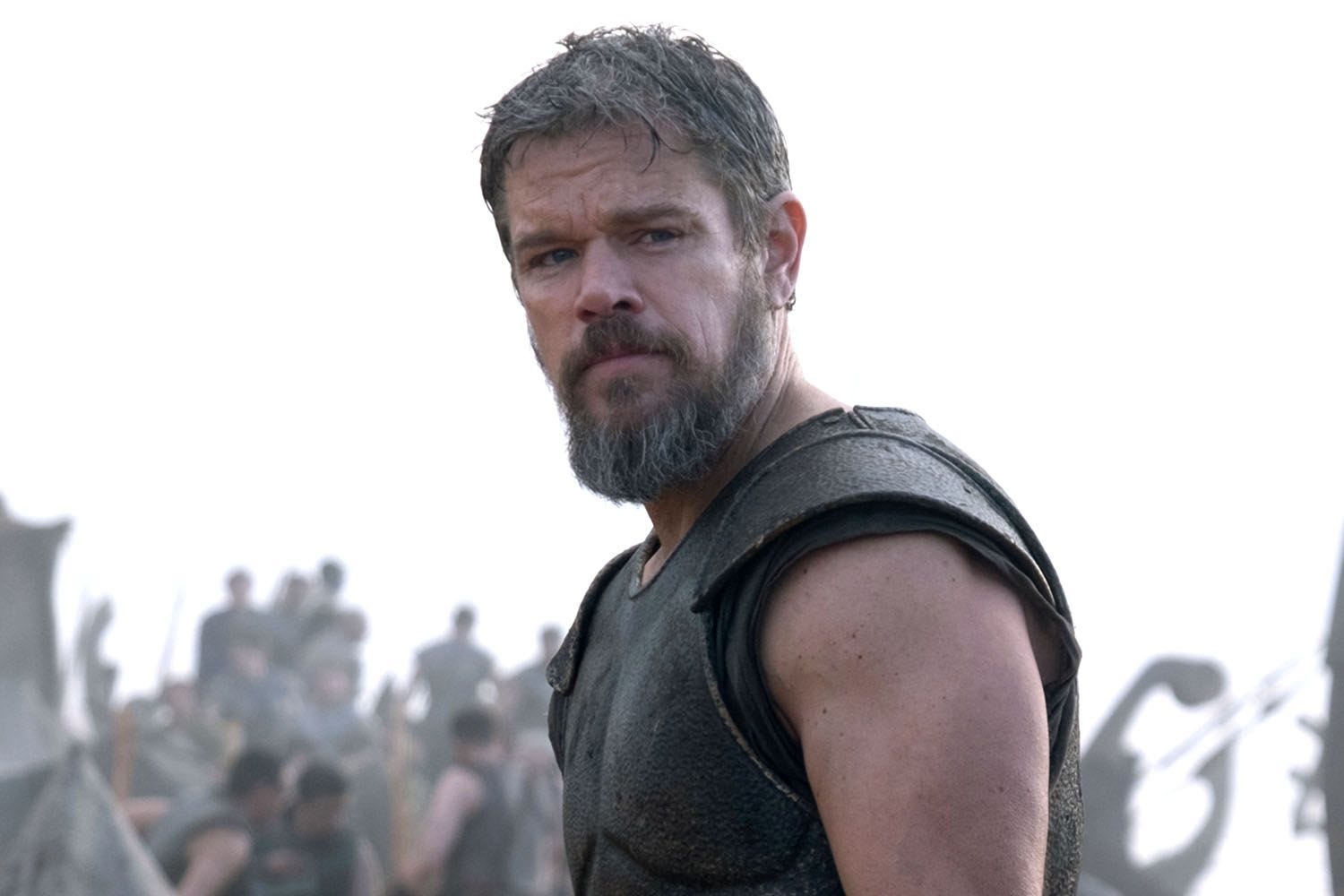
The Scylla-in-a-saucer over Christopher Nolan’s casting of Lupita Nyong’o as Helen of Troy is representative of both translating and filming The Odyssey: it can’t be done in a way that will satisfy everyone. Arguments about translations have been made since Keats first heard Chapman sing out loud and bold. When Nolan announced his new project, there were grumblings that he was biting off more than he should attempt to chew and complaints about helmets as proof that Nolan was offending the gods who keep the literary gates. But it’s Nolan’s strangely quiet audacity that has built his resume and reputation. He doesn’t think small. Why shouldn’t he make The Odyssey? So many complaints about Nolan’s attempt, made before the film was released, are reminiscent of those heard when people learned that Peter Jackson was daring to film The Lord of the Rings. But books are not the oxen of the sun-god, inviolable and unavailable to the hands of men. Besides, what could he possibly do after Oppenheimer?
It turns out that he made a kind of Oppenheimer II—another film about a destroyer of worlds and the effects of that destruction on its creator.

Jokes about spoilers abound online, but the fun of the movie is not what will happen but how Nolan will reshape the source.1 And reshape it he does. The suitor Antinous now has a backstory that helps explain his hatred of Telemachus; he’s like a politician panicking because someone has unearthed his unsavory past. Eumaeus, the loyal swineherd to whom Odysseus reveals himself, is here blind like his legendary creator, an inside joke and a move that reinforces the issue of moral vision: Eumaeus can see the wickedness of the suitors and Odysseus can see the future he helped create by destroying Troy. But the more important and, depending on your point-of-view, interesting or irritating reshaping is Nolan’s infusing the epic not with the sensibility of what the opening title calls “A time of apparent magic.” In other words, a time much like our own.
That “apparent” is made most clear by Nolan’s not including the gods except when they are mentioned by humans. The only one we see is Athena (played by the perpetually-sourpussed and completely miscast Zendaya), who doesn’t aid or even advise Odysseus as she does in the poem: here, she might be a hallucination that appears when the hero is having doubts. She’s like a frowning Clarence Oddbody to his George Bailey. The characters repeatedly invoke “the Law of Zeus,” which seems to be a combination of the golden rule and eighteenth-century combat conventions: it’s why Odysseus tells Telemachus that he cannot kill any of the suitors and why Odysseus has misgivings after using his greatest trick to open the gates of Troy. The “Law of Zeus” is the glue that holds society together, even when it is at war with itself, and much of the film is about that glue becoming brittle.
The grafting of a modern sensibility onto an ancient text might be a sin, but it might also be a way to make the hero more fathomable. There has to be something recognizable in ancient texts or we wouldn’t bother to read them: they’d be Sirens who lost their voices. Nolan’s Odyssey is like a staging of Shakespeare in an alternate setting or time, which we now expect and even demand: Richard Loncraine’s Great War version of Richard III or Ralph Finnes’ Coriolanus set in the contemporary Balkans don’t take away anything from the texts, but enhance elements of the plays that their directors find interesting. A similar thing is happening here. If Nolan had offered a rigidly faithful 1:1 correspondence between the pages and the frames, he’d be accused of literalism and a lack of imagination—and I’d be the first to level the charge. If he had been as faithful to Bob Kane as some wish he were to Homer, we’d never have the Dark Knight trilogy.
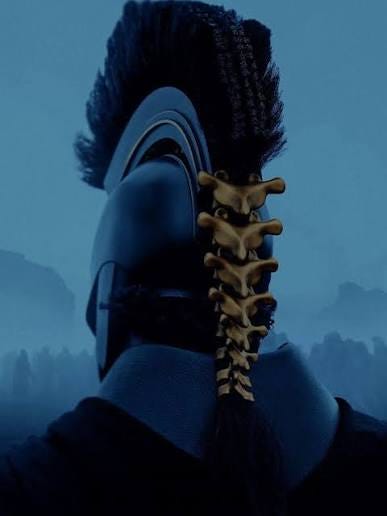
The best sequence in the film is the one in which we see the soldiers hiding inside the Trojan Horse, which has the suspense of countless other movie moments in which characters need to be silent. When Odysseus slides down a rope out of the horse’s stomach and takes out what must be the worst guard in the Trojan army2 to open the gates for Agamemnon, we are in a swords-and-sandals epic with fire, scaling walls, falling ladders, and flying furniture. The sack of Troy shows the dustup over Nolan’s choice of helmets as silly as it sounded before the film was released: Agamemnon’s, with its pony-tail of golden vertebrae, makes him as impressive as Darth Vader, whom he resembles throughout the film. Troy is his Alderaan and when we are told early in the film that Agamemnon is there to protect a trade route more than to save his brother’s honor, we believe it.
The Trojan Horse is Odysseus’s Trinity Test, which is why the film ends with him leaving the place it took him twenty years to reach: yes, he has to sail west and make a sacrifice to honor the unburied dead, but like other veterans who have seen horrors up close, he can’t go home again. Oppenheimer ends up as an academic at Princeton; Odysseus again takes to the sea. Los Alamos and Troy have changed the world and the man. The Sirens sing to him about what he most desires, but the film smartly never shows Odysseys enjoying what it took so long to attain. That’s the nature of so many of our (admittedly smaller) ambitions: we strive and achieve and then become anxious about what they cost. Of course, there is nothing in Homer to suggest (at least as far as I can see) that Odysseus would ever have a single pang of guilt about being the man of many wiles who created a trick even better than the one in The Prestige in order to kill as many Trojans as he could. The film assumes a modern view of warfare and death, which is why Nolan omits even a hint that the serving women and whores who cavorted with the suitors would be (as in Homer) strung up like choking birds:
Stern Telemachus gave the men their orders:
“No clean death for the likes of them, by god!
Not from me—they showered abuse on my head,
my mother's too! You sluts—the suitors’ whores!”
With that, taking a cable used on a dark-prowed ship
he coiled it over the roundhouse, lashed it fast to a tall column,
hoisting it up so high no toes could touch the ground.
Then, as doves or thrushes beating their spread wings
against some snare rigged up in thickets—flying in
for a cozy nest but a grisly bed receives them—
so the women’s heads were trapped in a line,
nooses yanking their necks up, one by one
so all might die a pitiful, ghastly death. (Fagles XXII:87-99)
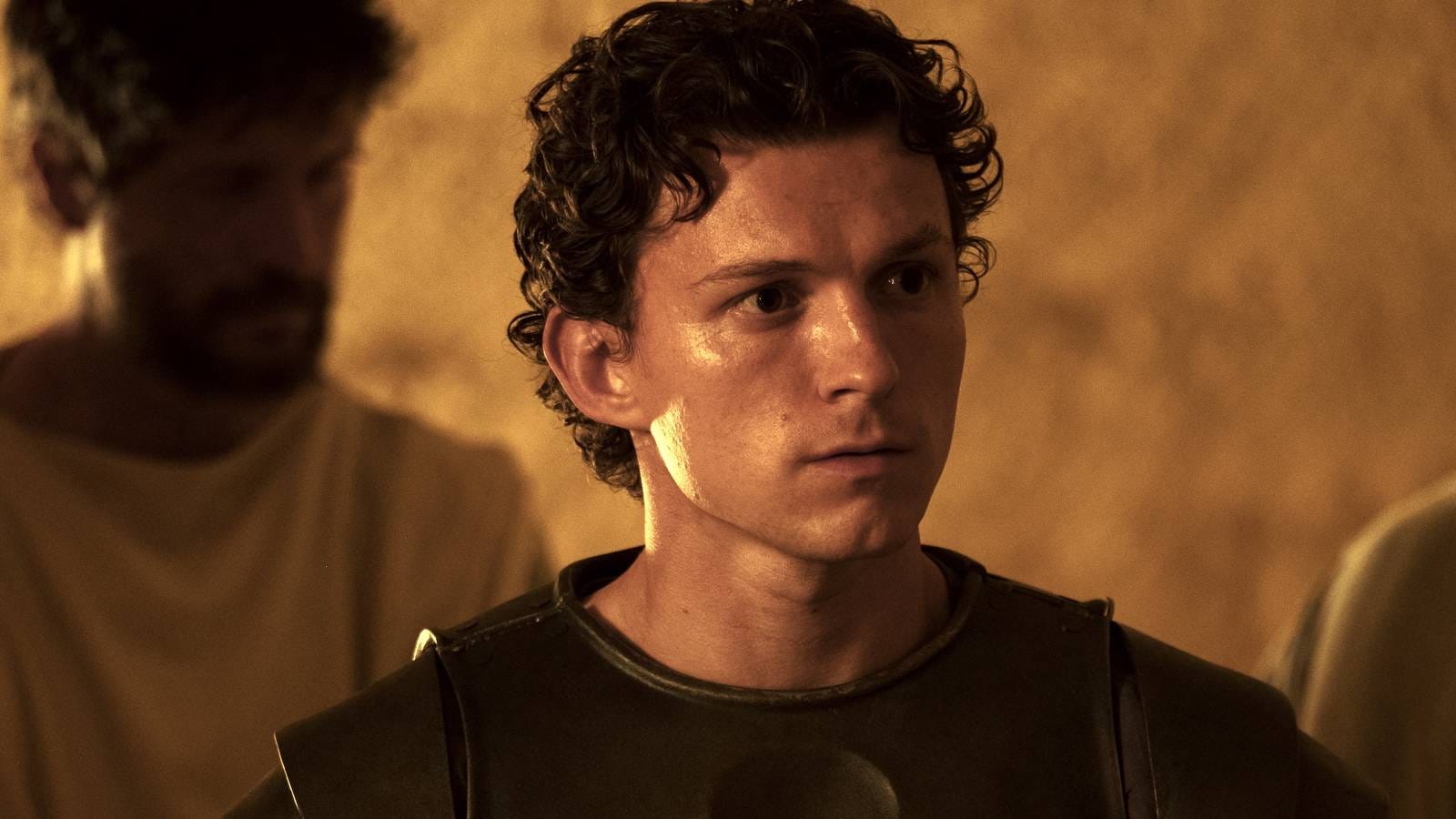
There’s no way that Nolan could have Tom Holland recite these words or complete these actions; including them would have changed the entire film.
Generally, it all works. But any attempt to immerse a viewer into an ancient world risks moments in which the veil is pierced and we are nudged ever so slightly back into being reminded we’re watching a movie. This happens occasionally in the screenplay: Telemachus says that he wants to find his “dad,” which is like seeing him wearing a baseball cap; Penelope says, “OK! OK!” in a moment of stress; one of the suitors (who is described as “partying”) tells Odysseus, in his beggar’s costume, to “F—k off”; and Odysseus complains in a flashback about “ten years on this f—ing beach.” These moments are small and are presumably included to make the characters more “relatable,” but they have the opposite effect, like a middle-school kid trying to act cool. Odysseus is not Telemachus’s “dad”; he’s his father. (“Father” may be as far as “dad” from the Greek πάτερ, but it registers more naturally in our ears in this setting.) Emily Wilson’s 2017 translation (which Nolan apparently used as a source) does this as well: we’re told that characters “had sex” and she calls the hero, in the opening line, a “complicated” man, as if we’re watching an episode of Friends.3 But these are glitches in the matrix of each work: there are so many pages and frames that these small moments are soon forgotten.
One of the best things about seeing the film was that I didn’t see it in IMAX and not once while I watched it did I wish that I had. A good movie draws us in regardless of the size of the screen. I saw it at a local independent theater in which everybody behaves, rather than an AMC bunker which shows thirty minutes of trailers and commercials, followed by people yapping and scrolling during the film. When, after the opening titles, someone near the top yelled, “DOWN IN THE FRONT—TURN THAT PHONE OFF,” it made the auditorium feel almost like Ithaca after the housecleaning.
When we see Hamlet, we all know what’s coming; the thrill is in how it will come in the production we’re attending.
He had one job.
“The One Where He Can’t Get Home”
A measured take. I loved the film, and I'm thankful Nolan tackled it the old-fashioned way (Old Hollywood era, not necessarily Homer era). It was almost like witnessing a Cecil B. DeMille epic on the big screen, only better.
"She’s like a frowning Clarence Oddbody to his George Bailey" woke up the dog sleeping next to me I laughed so hard! I'm more than done with all the Odyssey talk and have been for a while ... but the tight lens you took here, Daniel, was definitely worth the read. I am making it my last on the film because nothing else has even come close ...