

John Huston and James Joyce
The Dead

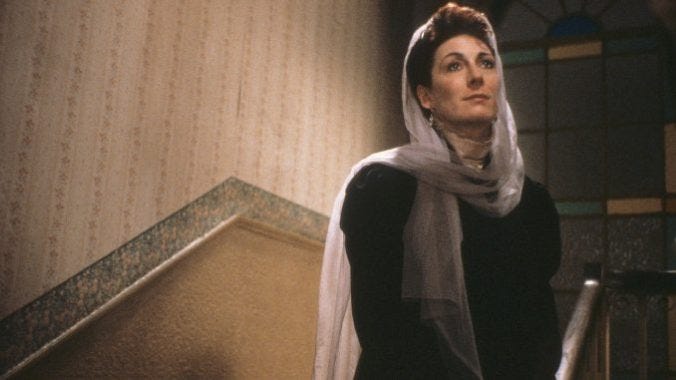
This essay accompanies this week’s episode of Fifteen-Minute Film Fanatics, a podcast that always breaks the premise of its title but never wastes the listener’s time. The post and the podcast complement each other; the post isn’t a summary of the podcast, so please give it a listen. We take requests; leave a comment below if there’s a film you’d like us to cover. We’ve done over three hundred episodes that you can find on Spotify, Apple, or wherever you get your podcasts. There’s also a player at the end of this post. Check out the back catalogue for episodes on your favorite films. It’s free everywhere, fueled by enthusiasm. Thanks.
First-time readers of James Joyce’s “The Dead” often ask the same two questions:
1. If the story’s real “action” is Greta’s revelation about Michael Furey, why is there so much beforehand about the party?
2. Why hasn’t Greta ever said anything about this to Gabriel?
Both of these are reasonable questions from intelligent readers—they’re actually the kinds of questions that intelligent readers ask, because they concern authorial decisions as opposed to, “What is the guy trying to say?”1
The first is best approached by thinking about who the story concerns. Gabriel Conroy is, as his name suggests, an angel to his aged aunts, who worry about his arrival and if he’ll be able to get the “stewed” Freddy Mallins presentable when he arrives. His aunts think of him like Don Corleone thinks of Michael.2 The annual dance on the Feast of the Epiphanny is “always a great affair” and a way for Joyce to show Gabriel’s values and assumptions as he interacts with the guests, a cross-section of Irish life. We learn that Gabriel, for all of his aunts’ esteem, is someone who thinks of himself as a tad superior to other people yet is also not as skilled at hiding his insecurities as he wishes. He’s a university teacher who thinks that “literature is above politics” but is rattled when Miss Ivors asks him why he writes book reviews for the pro-English Daily Express. He tours the continent on his bicycle “to keep up with the languages” and pooh-poohs the idea that there’s anything to see in Ireland, yet can’t think of a reason to not visit Galway when Greta asks him. He is well-read and intelligent, yet frets about his annual toast as if he’s about to address Parliament.
None of this is to paint Gabriel as a bad person, but one a few degrees away from the reader. We’ve all been like Gabriel and will be again. His primary trait is that he’s not wholly capable of imagining the inner lives of other people, a condition that will be corrected at the conclusion. Without the party, “The Dead” would lose its power because the reader wouldn’t be able to appreciate the effect of Greta’s story on Gabriel. Michael Furey would be only a ghost instead of the teacher Gabriel needs to become more fully human.
The second question—why Greta never told Gabriel the story—is easier to answer. When would be a good time? Note that Greta has not been pining away in secret over Michael Furey; the story suggests that she has locked that memory away and nearly forgotten it until the chance singing of “The Lass of Aughrim” hands her the key. We all contain multitudes and marriage is an exchange of vows, not multivolume memoirs. And how would a man like Gabriel respond to such a story? He’d be arch or ironic, as he almost is at the end when he hears the story; it’s only the sincerity of Greta’s sobs that make him realize that irony is no match for real emotion:
Generous tears filled Gabriel’s eyes. He had never felt like that himself towards any woman, but he knew that such a feeling must be love. The tears gathered more thickly in his eyes and in the partial darkness he imagined he saw the form of a young man standing under a dripping tree. Other forms were near. His soul had approached that region where dwell the vast hosts of the dead. He was conscious of, but could not apprehend, their wayward and flickering existence. His own identity was fading out into a grey impalpable world: the solid world itself, which these dead had one time reared and lived in, was dissolving and dwindling.
Gabriel’s tears are “generous” because they are being shed for another. This is a sign of his growth, the opening up of himself and imagining the lives of others—but what a cost! What a punishment for the petty crimes of self-assurance and pride! He learns that what he regarded as love was a pale imitation of that felt by the “young man standing under a dripping gumtree.” Imagine learning this about yourself: you think your love for your wife is a 10 out of 10 and then you learn that someone else, years ago, was at 11.
Gabriel is cuckolded by a ghost—but this is only the beginning of his revelation. As he stares at the snow that, somewhere, is covering Michael Furey’s grave, Gabriel thinks of how his present world, with all of its problems and his preoccupations, is insignificant in the face of eternity:
The air of the room chilled his shoulders. He stretched himself cautiously along under the sheets and lay down beside his wife. One by one, they were all becoming shades. Better pass boldly into that other world, in the full glory of some passion, than fade and wither dismally with age. He thought of how she who lay beside him had locked in her heart for so many years that image of her lover’s eyes when he had told her that he did not wish to live.
Like the Wedding Guest after listening to the Ancient Mariner, he will awake a sadder and wiser man.
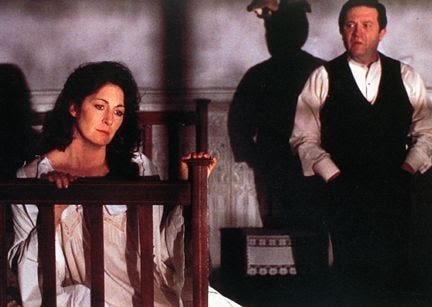
The story’s title obviously refers to the character who shows Gabriel that his emotional armor isn’t as strong as he thought. No galoshes will keep the snow that is general all over Ireland from falling on his aunts’ graves or his own. Yet the title also refers to all of the dead whose presence is felt throughout the story, whether it be the names of past tenors or family members who still interact with the present: at the party, Gabriel finds himself still quarreling with his dead mother about Greta, the guests speak of great singers of the past who used to perform in Dublin, and Mr. Browne learns that the monks at Mount Mellaray sleep in their coffins “to remind themselves of their last end.” Even “The Lass of Aughrim” is a “dead,” i.e. not contemporary, song that affects Greta more than any of Mary Jane’s piano playing ever could. In Flannery O’Connor’s The Violent Bear It Away, the backwooods prophet Mason Tarwater builds his own coffin; when his nephew, a very Gabriel-like teenager, mocks the idea of sacred burial, the old man scolds, “The world was made for the dead. Think of all the dead there are … There’s a million times more dead than living and the dead are dead a million times longer than the living are alive.” Dublin is where the dead walk and Michael Furey, a poor, uneducated seventeen-year-old, is, in one sense, more alive than Gabriel.
And when we read the story or watch the film, everyone in it falls under the heading of the title. Dubliners was published in 1914; “The Dead” takes place on January 6, 1904. Joyce’s first readers were already entering a world in which the dead—people from the past—are alive and interacting with the present as the reader turns the pages. To anyone watching the film over seventy years later, the characters and setting seem even more remote. Yet they are still alive in the sense that we recognize them as believable people—in other words, like how Greta and eventually Gabriel recognize the presence of Michael Furey. Huston died on August 28, 1987 and The Dead, his final film, premiered on December 17, 1987. He was still speaking to us after his passing, just as Joyce and so many others long dead are standing outside our windows, calling for our attention.
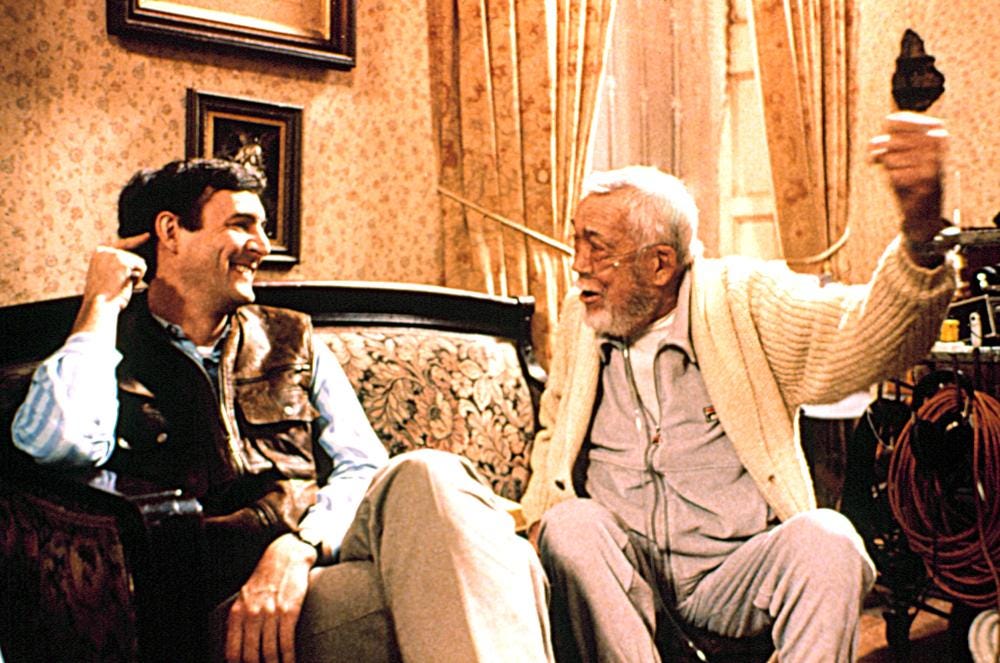
As Gabriel reviews his speech and smarts over Miss Ivor’s playfully calling him a "West Briton,”3 he thinks of a phrase from one of his recent reviews of a poetry collection that she had previously praised: “One feels that one is listening to a thought-tormented music.” Thought-tormented music will be heard at the Misses Morkans, but not as part of the official program. As with his understanding of love, Gabriel thought he understood something very well—well enough to opine about it in print—but learns how much he has fallen short. As Al Jolson said, “You ain’t heard nothin’ yet.”
In The Merchant of Venice, Lorenzo states that a man “not moved with concord of sweet sounds” cannot be trusted, because he is not fully human: “The motions of his spirit are dull as night / And his affections dark as Erebus.” Both Joyce and Huston, on their pages and in their frames, get us to hear the music that makes us more human.
Listen to the episode here or wherever you get your podcasts:
Nabokov says someplace that this is the classic bad question posed by literature teachers. He’s not wrong.
Recall that at Connie’s wedding, the Don won’t take the family picture until Michael arrives.
Someone who looks to England to solve Ireland’s problems.
What amazes me about the film is how deep the understanding of the story runs. It’s more than a “great adaptation,” it’s a sounding that allows the story to reverberate. I looked at it again a couple weeks ago and I was taken aback. It’s only grown over the years.
As a side note, Rossellini borrowed the Michael Furey idea for VOYAGE TO ITALY. It’s closely related, because everywhere Ingrid Bergman goes she’s overwhelmed by abundant life and constantly reminded of mortality.
Another side note. As I read the part in your essay about the O’Connor novel, I remembered that Emerson’s aunt slept in a coffin, always ready for death.
P.S. Nabokov was absolutely right.
Thanks for the restack!