

Red in Tooth and Claw
Grizzly Man

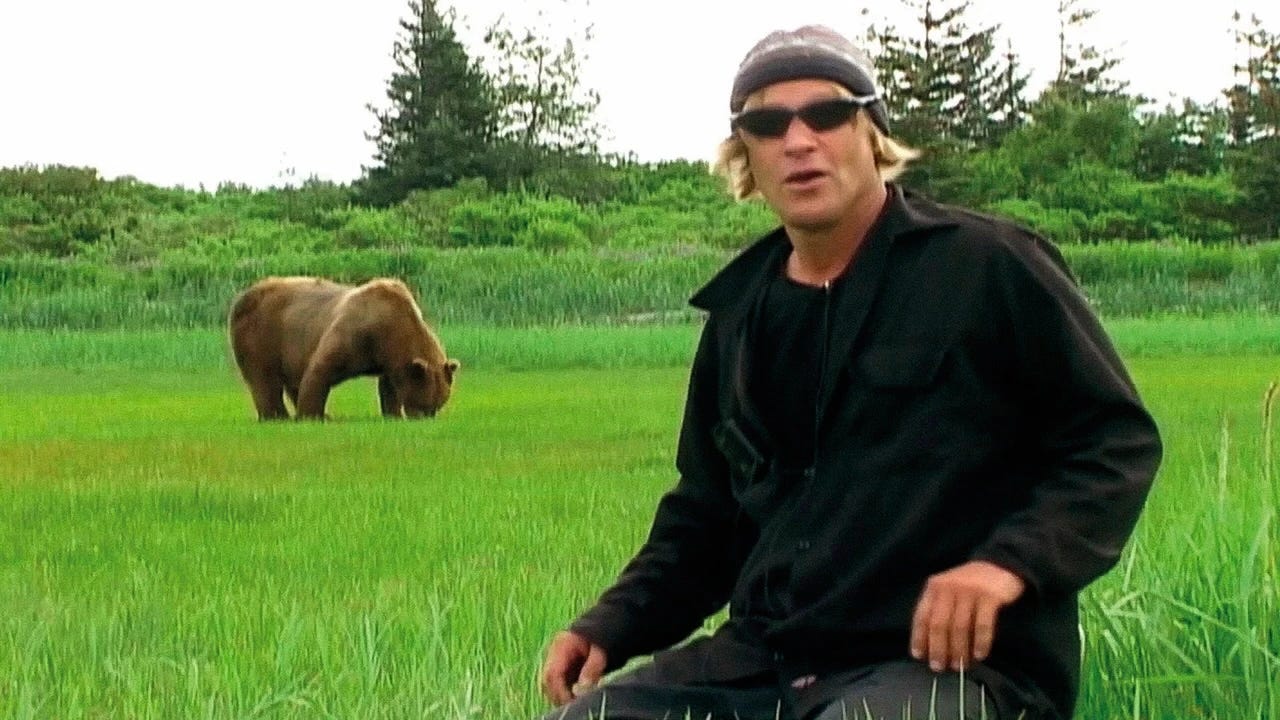
Tennyson called nature “red in tooth and claw,” but that warning didn’t keep Timothy Treadwell from living among the grizzlies of Alaska for thirteen summers—until the October day in 2003 when one of them killed him and his girlfriend. Werner Herzog’s 2005 documentary Grizzly Man tells Treadwell’s story and raises the issue of what happens when we truly impart human characteristics to animals. Allowing Bambi and Thumper to have emotions analogous to ours is fun as an imaginative experiment in the dark, but believing that this state of affairs exists is another thing. The film also explores the ways in which we all attempt to stake out our own territory in an indifferent world by ignoring the facts that threaten what we want to be true.
Treadwell was a troubled man, regardless of how much joy he projects in the films he made in Alaska. He clearly wanted something from his ursine family that he couldn’t get from his human one, who, when they first appear, almost seem too on-the-nose as one of the reasons why Treadwell wanted to reinvent himself. He would become The Grizzly Man, just as in elementary school we were all excited when The Snake Guy came for an assembly. He repeatedly claims that he is “guarding” and “protecting” the bears, but they don’t need his protection. The National Park Service has sensible rules regarding bears, but Treadwell can’t have them undermining his efforts. As if they were in an old Western, Alaska isn’t big enough for both of them and if the Park Service abides, he sees this as a net loss in a zero-sum game of animal empathy. He screams, “Animals rule! Timothy conquered. F— you, Park Service,” but the yells are as misguided as they are prophetic. In the wild, the animals do rule.
Treadwell’s (literally) fatal flaw is assuming that bears are capable of emotions like the ones he feels for them. He talks about gaining their “respect,” but respect is as alien and unknowable to a bear as a painting is to a man blind since birth. Sam Egli, the helicopter pilot who found Treadwell’s and his girlfriend’s remains, says, “He was acting like he was working with people wearing bear costumes instead of wild animals.” Treadwell also wanted to be as wild as his subjects; the movie could be retitled Diary of a Failed Werebear. Thomas Nagel’s famous essay, “What It Is Like to Be a Bat” concerns the impossibility of understanding subjective experience: just as we cannot conceive a world navigated by echolocation, the bears cannot conceive of Treadwell as a companion. The bears don’t love him, hate him, or have any opinion of him because they are incapable of these emotions. In a voiceover, Herzog explains:
What haunts me, is that in all the faces of all the bears that Treadwell ever filmed, I discover no kinship, no understanding, no mercy. I see only the overwhelming indifference of nature. To me, there is no such thing as a secret world of the bears. And this blank stare speaks only of a half-bored interest in food. But for Timothy Treadwell, this bear was a friend, a savior.
Humans and bears share the same earth but not the same experience or means of apprehending that experience.
None of this is to mock Treadwell or suggest he got what he deserved. (As Hamlet asks, “Use every man after his desert and who shall ’scape whipping?”) Grizzly Man is a portrait, not a lesson. Like Christopher McCandless, the protagonist of Jon Krakauer’s Into the Wild, Treadwell evokes our sympathy as we shake our heads.
Herzog’s 2025 book The Future of Truth illuminates Grizzly Man without ever mentioning the film, as when, for example, Herzog states, “A willingness to deceive ourselves seems to be an essential part of our makeup” (70). Treadwell’s self-deception earns our pity, not our scorn. He believed it all because he felt he was right, not because of any facts or data he had amassed. He was a Romantic, not an empiricist. Elsewhere in The Future of Truth, Herzog argues that, regardless of the facts, “feelings are always authentic” (40) and Grizzly Man dramatizes a fatal substitution of feelings for facts. In a 2019 interview, Herzog explained:
In the film you see lots of footage where he steps very close to a bear with his own camera. You see him touching the face of a bear and he’s singing songs to bears and he wants to hug the bear … and it’s a tragic misunderstanding, a philosophical misunderstanding, of what wild nature is all about. It’s a very tragic story and nobody should die like that.
Grizzly Man is an example of what Herzog calls “ecstatic truth”: a “layer of truth” that “can illuminate us, far beyond the reach of fact” (81). Michelangelo’s Pietà is tremendously moving despite the factual “error” (which, of course, is not an error but a stroke of genius) that the Virgin Mary is, at the time of the crucifixion, the age at which she gave birth to the Son whose body she holds. Daniel Defoe’s 1722 Journal of the Plague Year is all from Defoe’s imagination—yet “No one else gives you such deep insight into horror as Defoe” (91). Facts may be skewed, as with the Pietà, or wholly invented, as with Defoe, but the truth of the work lies in the reaction these “facts” evoke. To Herzog, documentarians should never be flies on the wall: one of his rules is that a filmmaker must interfere to tell the story and get at its truth. Cinéma vérité mistakes facts for truth, just as Treadwell did, by ascribing “respect” to a bear.
Treadwell’s facts about bears are all wrong, but that doesn’t concern him. He thinks he is in the presence of something true, which is why we sympathize: we have all ignored facts that didn’t suit us. We point out AI’s “hallucinations,” its omitting or distorting the facts, to show our superiority, but we give ourselves a pass when we do the same. When it comes to ourselves, we can hallucinate as much as the Merry Pranksters.
You can find this week’s episode of Fifteen-Minute Film Fanatics in which we discuss Grizzly Man wherever you get podcasts. Please subscribe to the show—every episode is free—and consider leaving a review on Apple Podcasts or Spotify.
I saw it in the cinema, once, about twenty years ago. I've never watched it since and remember it with horror - Herzog's face when he is listening to the audio of Treadwell and his girlfriends death.
Its true we tend to deceive ourselves. Treadwell was living in a very dangerous fantasy world. But we also mediate our reality through images, which is not exactly the same thing in all cases. It is when Disney tends to be that mediator through which we understand wild animals. I remember reading in the New Yorker about a guy who collected wild animals in his Bronx apartment. He was caught when he went to hospital with some bad bites. When the police took him away, he said, 'I want the animals to interact like in the Jungle Book.' I saw a gut wrenching video on facebook over the weekend - a baboon had stolen a lion cub, taken it up a tree and is grooming it. It's not absolutely clear what's coming, except for that, when the lion cub tries to move it away, the baboon won't let it move around. It's clear, as some commentators observed, that the baboon was going to kill and eat the lion cub. The 'grooming' was actually cleaning it up before consumption. But nearly all the commentators reacted to the reel by saying 'Samba!' He's going to make it the King of the Jungle! One commentator even mentioned with glee that everyone was reminded of the Lion King. Of course you could say that my reaction of being sickened and sad for the lion cub was equally anthropomorphic projection - my thought was precisely, no wonder CS Lewis makes a gorilla the anti-Christ! We may know nature is red in tooth and claw, but we do not normally see it close up in action.
One of those few great films… that I can’t bear to watch twice 🐻