

Lost in a Film
The Purple Rose of Cairo

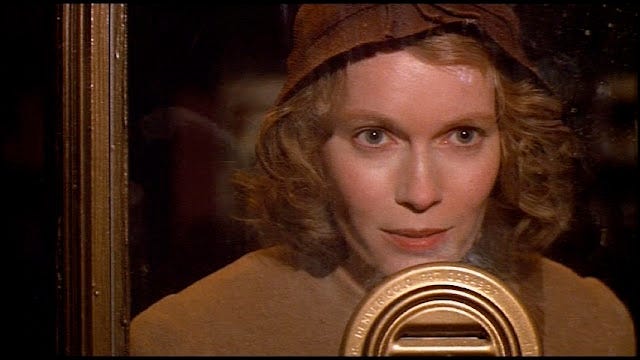
This essay accompanies this week’s episode of Fifteen-Minute Film Fanatics, a podcast that always breaks the premise of its title but never wastes the listener’s time. The post and the podcast complement each other; the post isn’t a summary of the podcast, so please give it a listen. We take requests; leave a comment below if there’s a film you’d like us to cover. We’ve done over three hundred episodes that you can find on Spotify, Apple, or wherever you get your podcasts. There’s also a player at the end of this post. Check out the back catalogue for episodes on your favorite films. It’s free everywhere, fueled by enthusiasm. Thanks.
There’s a maneuver that English majors try when they aren’t entirely sure what to say about an assigned reading: claim that the book is really “about” its form and then wait for the hushed awe of their professors. “Well, you know,” they’ll say. “Emma is really ‘about’ the novel—it’s Austen investigating the very idea of the novel.” Or, “The Waste Land is ‘about’ nothing less than the decay of civilization—and of poetry itself.” I never did this kind of thing, always taking it as an unintentional white flag, a sign that the student next to me was at a loss for words and ideas.
This also works with films. Every major director could be regarded as creating films that are “about the movies.” This is probably why the Family Guy clip about The Godfather is so often-quoted and shared: while Peter doesn’t claim that The Godfather is “about the movies,” the clip perfectly parodies the kind of critical remark that gets circulated without question.
Sometimes, of course, the maneuver works. Six Characters in Search of an Author is very much “about” the theater and Ulysses makes Joyce’s presence as novelist apparent on every page. Nabokov’s whole career was about “aurochs and angels, the secret of durable pigments, prophetic sonnets, the refuge of art.” And there are, of course, films that explore the viewer / film relationship. I’m not thinking of ones like Sunset Blvd or Singin’ in the Rain, or Adaptation, which are about the industry, but ones like Rear Window that dramatize the experience of watching a movie. Woody Allen’s The Purple Rose of Cairo (1985) is probably the most perfect dramatization of the experience of watching a film—even more so than Rear Window, the usual candidate, since there’s no metaphor.1 When Jimmy Stewart stares across the courtyard, he is like a person in a theater; when Mia Farrow becomes “absorbed” in her favorite screwball comedy, it literally happens.
Cecila (Mia Farrow) is a good soul living through bad times. She’s a clumsy waitress who breaks plates and cups and is yelled at and eventually fired by her offscreen boss. As Bob Dylan sang, everything is broken. Her husband, Monk (Danny Aiello), another yeller, is a brutish lout who pitches pennies all day and scores just short of Jake LaMotta on a scale of repulsiveness. (When Cecila tells him she’s leaving him because he hits her, he replies, “I never just hit you, I warn you first. And then if you don’t shape up, you get whacked.”) But her problems aren’t unique to her corner of New Jersey: the whole country is in the middle of a depression that mirrors Cecila’s own. The only relief is found at the movies, where shabby walk-ups become penthouse apartments, hash becomes caviar, and Danny Aiello becomes Jeff Daniels. In Sullivan’s Travels, the convicts watch a movie inside a church and Cecilia goes to the movies for the same reasons. She may as well be praying.
The idea of art as a refuge from reality—as a way to get reality “right,” the way it should be—has a long tradition. Hamlet writes a scene in The Murder of Gonzago so that the Player Queen shows the grief that Gertrude does not; Stephen Dedalus turns an awkward moment from his adolescence into a beautiful villanelle addressed to the “lure of the fallen seraphim.” At the end of Annie Hall, we see a scene from a play in which Alvy (Allen) and Annie (Diane Keaton) reconcile, after which Alvy looks at the camera and says, “What do you want—it was my first play. You know how you’re always trying to get things to come out perfect in art because it’s real difficult in life.” It’s a theme that Allen also explored in his 1977 story “The Kugelmass Episode” (performed here in a full recitation by Paul Rudd when he was a high-school senior) in which a fat and bald oaf is transported into Flaubert’s novel and has an affair with Emma Bovary, who is smitten with the chubby, balding, never-to-be leading man:
“I love what you have on,” she murmured. “I’ve never seen anything like it around here. It’s so . . . so modern.”
“It’s called a leisure suit,” he said romantically. “It was marked down.” Suddenly he kissed her. For the next hour they reclined under a tree and whispered together and told each other deeply meaningful things with their eyes.
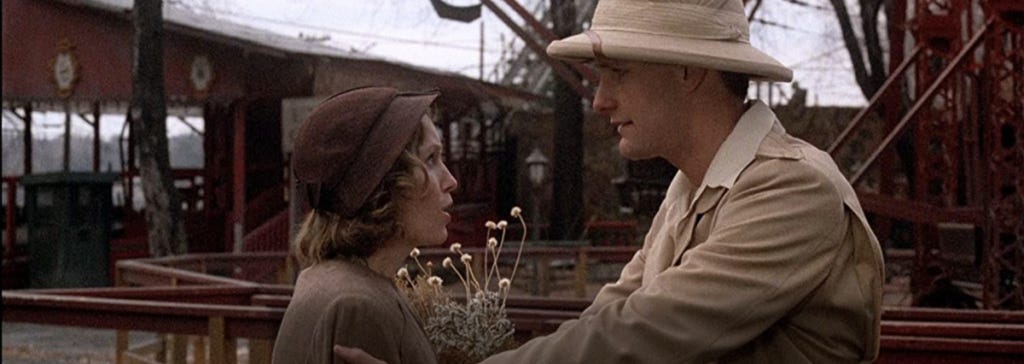
In Cairo, Allen has the cake of this joke and eats it, too: Cecilia gets to enter the world of the film (funny), but the film also enters hers (very funny). Every joke about these situations lands, like Cecilia telling the characters that the champagne is really ginger-ale or the once-onscreen Tom Baxer (Jeff Daniels) trying to pay for dinner in the real world with movie money. Tom Baxter is as enchanted with our miserable world as Cecilia is with his magical one. And when Gil Shepherd, who plays Tom Baxter, is told by his agent that he needs to get to New Jersey and convince the character he plays in The Purple Rose of Cairo to get back onto the screen because the characters up there are stuck in the third reel, Allen’s film moves closer to farce and the jokes multiply.
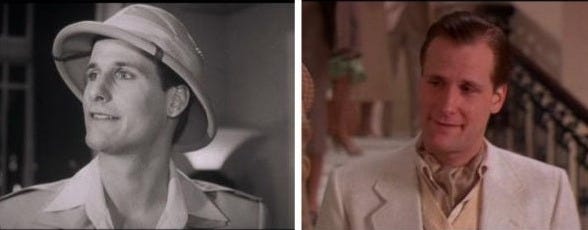
What keeps it from being only a series of gags is Cecelia’s reaction to things. Both Tom Baxter and Gil Shepherd have told Cecilia they love her and each has his merits: Shepherd is a sophisticated movie star who promises to take her to Hollywood, while Baxter is innocent and effusive in his boyish adoration. As Cecila says of Baxter, “He’s fictional but you can’t have everything.” Yet neither of them fulfills his promise. Cecilia chooses Shepherd, who convinces Baxter to return to the screen, yet then abandons Cecelia once the crisis has calmed, leaving her to learn the hard way that celebrities are as self-centered as everybody else, only more so. Alone with her suitcase and ukulele, Cecilia goes to the only place left for her: the movie theater, when she watches Fred Astaire and Ginger Rogers dancing cheek to cheek. “Heaven,” we hear. “I’m in Heaven.” The last minute of the film is a close-up of Cecilia slowly smiling and being drawn back into the world she prefers. It’s moving and sad and the only way Allen could have ended it.
Allen was pressured by Orion to shoot a happier ending, which he refused to do. And while the ending isn’t the upbeat one the executives wanted, there is some degree of happiness: the world may be New Jersey, but you don’t always have to live in it, an idea that Allen used in the very same way (with the Marx Brothers) at the end of Hannah and Her Sisters. He could have had Cecilia live with Tom Baxter in his world, but that would be a cop-out, the equivalent of Cypher deciding that he would rather eat a fake steak than try to take down the Matrix. If anyone could live in a screwball comedy, all of those films would lose their charm. One also must remember that Cecilia isn’t tempted to live in “the movies” but one from a particular lovable and pleasant genre. Living in His Girl Friday would be tempting, but who would want to live in Apocalypse Now? Living in a novel by P. G. Wodehouse would be wonderful, but what about one by Cormac McCarthy?
In a 1962 lecture, Flannery O’Connor said, “I am always highly irritated by people who imply that writing fiction is an escape from reality. It is a plunge into reality and it’s very shocking to the system.” Writing fiction, yes. But sometimes reading it or watching it on a screen is exactly the escape we need. It’s like Heaven.
Listen to the episode here or subscribe wherever you get podcasts:
I don’t claim that Purple Rose is a better film than Rear Window, just that it dramatizes the experience more directly. Don’t get excited.
Purple Rose is a minor masterpiece. Great review.
Like some of the other aficionados in this corner of Substack, I am enraged that a movie could be about anything other than itself, or deviate in jot or tittle from the source material.
Richard III? Clearly a megalomaniacal humpback. Any attempt by Ian McKellen, or any other pretentious sophisticate, to set this drama in the 1940s is nonsense.
West Side Story? Trash.
Apocalypse Now? Excuse me, what do the Viet Cong have to do with this?
Field of Dreams? I say let the ghosts play baseball and stop unpacking your own baggage about the male experience. And the book was probably better without Darth Vader anyway.