


You can listen watch the interview in the player above or listen wherever you get podcasts.
When Willy Loman’s neighbor, Charlie, complains that he has heartburn, Willy tells him, “It’s because you don’t know how to eat.” Adam Reiner, author of The New Rules of Dining Out: An Insider’s Guide to Enjoying Restaurants (LSU Press) would argue that we don’t know how to dine and that the more we understand how restaurants work, the better experiences we will have when we visit them.
Reiner’s title will raise some eyebrows. How to cook, host, serve—all of those books make sense and belong on the same shelf as The World Atlas of Wine and Setting the Table. But a book about how to enjoy a restaurant? What more is there than, “Order, wait, eat slowly, and leave a respectable tip? I need someone who won the James Beard Award to explain this to me? Am I missing something?”
It turns out I was. Dining out always seemed to me like a series of one-way signals from guest to server to kitchen, with the success of the experience based on how well those signals were received. But Reiner, who has waited and worked in some of New York City’s most popular restaurants, argues that the relationships between guests, servers, maître d’s, bartenders, and chefs create an ecosystem in which a request for a dish prepared differently than described on the menu or a lack of interest in the experience can affect the whole experience—like the butterfly effect of dining. “Over the last twenty years,” Reiner writes, “we’ve become a generation of more educated eaters, but we haven’t become more educated diners.” The goal of his book is to teach his readers the skills that will make them better patrons and, as a consequence, have better experiences when they go out to eat.
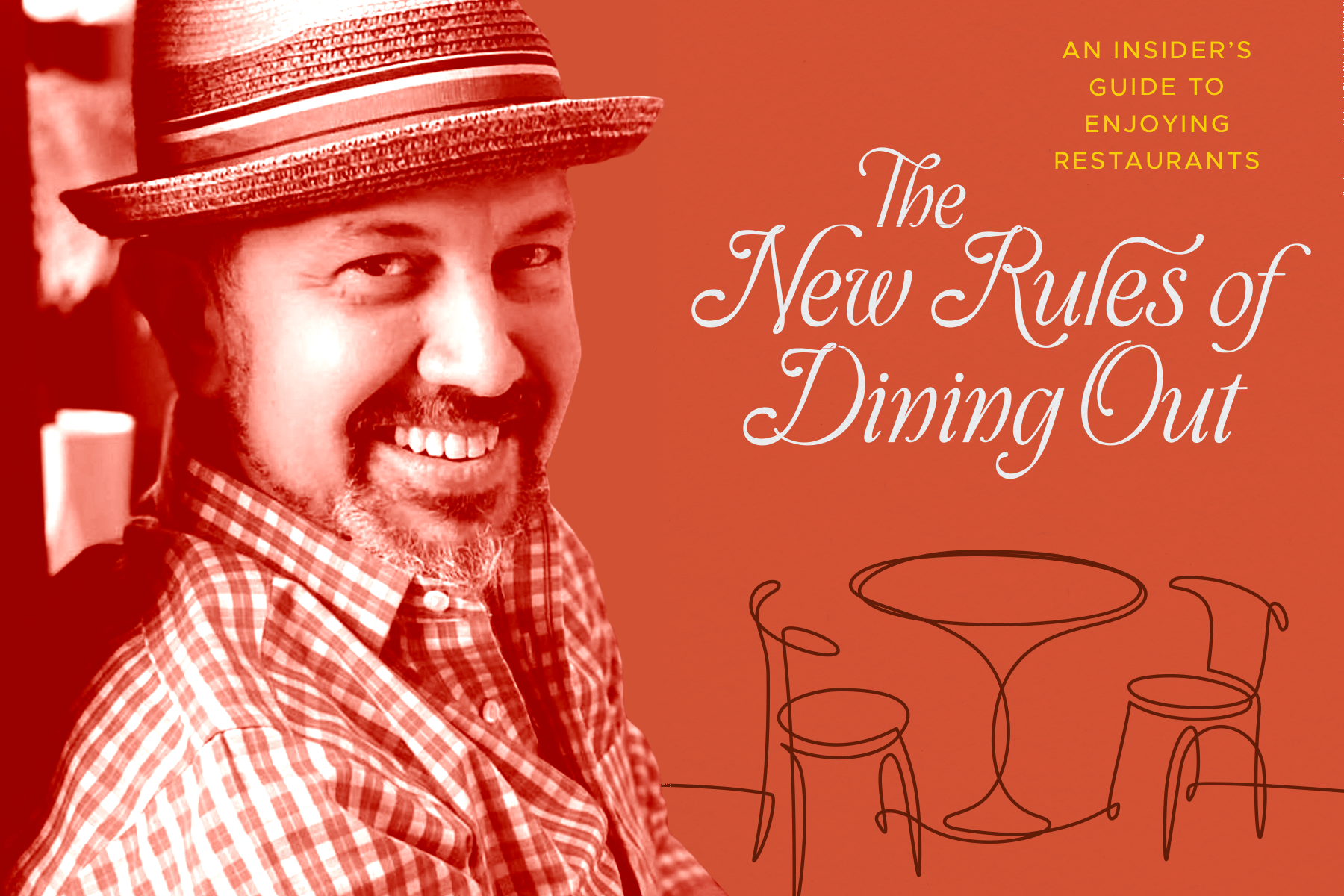
The appeal of Reiner’s book is that he imparts these lessons without pretense. He is not a modern Miss Manners, scolding us for not understanding the differences between maitake and shitake mushrooms. He’s a true believer in the value of restaurants as both places to meet and places to work and wants readers to appreciate how guests have more to do with the success of a meal than they may suspect. “Society’s deeply ingrained ideas about hospitality,” Rainer writes, “have conditioned guests to believe that restaurants bear full responsibility for the success or failure of their meal”—a conditioning he questions throughout The New Rules.
Because we all go to restaurants, we all have opinions about how they should work. Yet few of us have a knowledge of how these systems operate, which is why Reiner states in his opening pages, “I can’t think of any subject that more random people will claim expertise about than restaurants.” He’s not wrong: quality criticism should be based on knowledge and one of the strengths of The New Rules is how it guides the reader through different parts of a restaurant and how they interact. Readers learn, for example, how Chef Auguste Escoffier popularized what’s known as “the kitchen brigade,” in which each person has a specific role to play in order for the restaurant to complete its mission. That “brigade” is a military term is no accident: like an army, the staff of a restaurant needs to work in concert, respect hierarchies, and follow orders. Great service and food don’t simply happen; they are the result of trained people effectively managing information. When a restaurant doesn’t “know its own limits” is when the system begins to break down. Readers also learn why menus have a logic to them that allows the brigade to operate with maximum efficiency, which is why Reiner reminds us that “a restaurant chef is not a private chef.” Thinking that one’s chef for the evening is one’s chef for life leads to defeated expectations, increased tension, and a greater chance of something going amiss.
Some of Reiner’s Rules concern how to interact with one’s server. He’s adamant about being present while interacting with a waiter: not overly-cheerful or personal, but connecting instead of scrolling through the phone while half-listening to the specials or telling the waiter as soon as one’s seated, “I know what I want.” Complaining about a bartender’s pour, asking vague, unanswerable questions like, “What’s good here?” or ordering steak between the three traditional levels of doneness (“Can I get that well-done, but juicy?”) puts a waiter in an impossible situation. Reiner explains how to communicate that you don’t want to be rushed, how to handle what might be negligent service, and even what to do with a wobbly table.
Of course, not every restaurant is perfect. Things go wrong all the time, just as they do at work, with one’s family, or just being alive. Yet Reiner argues, “The same things that make you a successful friend, lover, sibling, coworker, or spouse also make you a great restaurant guest.” How we deal with setbacks in general transfers to the table in particular and our attitude colors everything, which is why “you can have great experiences in bad restaurants and you can have bad experiences in great restaurants.”
As I read The New Rules, I kept thinking about how restaurants are like theaters. We go somewhere and pay others to create an experience for us; how we enter and behave in that space will determine what we get out of it. This is not to say that seeing a terrible movie in a state of “mindfulness” will make us enjoy it, but that being aware of our interaction with what’s being presented on the screen or on the table can increase the odds that the trip was worth the cost. Watching movies and eating at home are always less expensive than going to theaters or restaurants, but leaving one’s home to be served among strangers has rewards we can’t always find on our couches or in our kitchens.
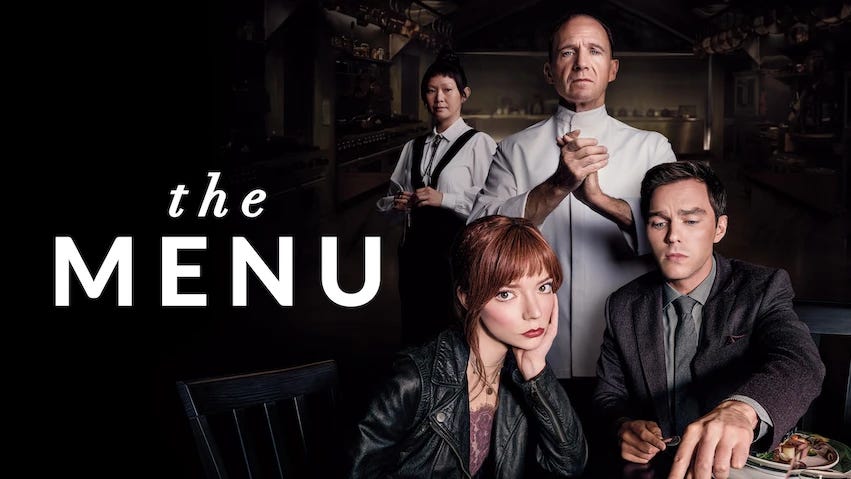
The theatrical nature of restaurants is part of what makes the satire in The Menu, Mark Mylod’s 2022 satire, so sharp: Chef Slowik (Ralph Fiennes) is as much of an impresario as a chef, narrating each course and commanding his staff like Gunnery Sergeant Hartman. At the start of the film, Chef Slowik seems to have read Reiner’s book, telling the guests:
Over the next few hours you will ingest fat, salt, sugar, protein, bacteria, fungi, various plants and animals, and, at times, entire ecosystems. But I have to beg of you one thing. It’s just one. Do not eat. Taste. Savor. Relish. Consider every morsel that you place inside your mouth. Be mindful. But do not eat. Our menu is too precious for that.
Yet his sinister design turns the evening into a combination of And Then There Were None and The Most Dangerous Game, in which the pretentious, the arrogant, the lazy, and the lying all receive their due. Food becomes secondary to its presentation and the film mocks the degree to which fanboy foodies (such as Tyler, played by Nicholas Hoult) will justify anything done by a celebrity chef (like giving people dipping sauces without bread) as genius. Only Margot (Anya Taylor-Joy) can speak for the audience and for anyone who has ever rolled their eyes at someone gushing over “mouthfeel”:
MARGOT: I don’t like your food, and I would like to send it back.
CHEF SLOWIK: I’m sorry to hear that. What about my food is not to your liking?
MARGOT: For starters, you’ve taken the joy out of eating. Every dish you served tonight has been some intellectual exercise rather than something you want to sit and enjoy. When I eat your food, it tastes like it was made with no love.
CHEF SLOWIK: Oh, this is ridiculous. We always cook with love. Everyone knows love is the most important ingredient.
MARGOT: Then you’re kidding yourself. Come on, Chef. I thought tonight was a night of hard home truths. This is one of them. You cook with obsession, not love. Even your hot dishes are cold. You’re a chef. Your single purpose on this Earth is to serve people food that they might actually like, and you have failed. You’ve failed. And you’ve bored me. And the worst part is I’m still hungry.
In our conversation, Reiner shares these sentiments when he talks about how journalists are often invited to new “dining experiences” where PR agencies try to get new restaurants on journalists’ radars and where so much of the experience is “obviously pandering to get Michelin stars”:
Everything is so overwrought and the conventions of what they’re trying to do are obviously not really coming from the heart—and the places that I really end up loving are the ones that are much more humble and honest, where you have just food simply prepared and beautifully done and in an environment where the people working there seem to feel comfortable in their own skin, as opposed to where there are three different sets of hands in your space when they’re putting down all of these different ramekins and silverware and whatever it is … And then every course comes with a sermon, you know: “The chef found this ingredient on his travels to Uganda,” and you’re just like, “Come on, man.” Particularly with ultra high-end fine dining, you start to see some of these things that are used in the cooking, like caviar and uni and truffles and whatever—and you often have these dishes where you’re like, “This doesn’t even need these ingredients and the only reason you’re putting these things in there is because you want to call attention to how luxurious it is.”
This is conspicuous consumption at its nearly-literal best.
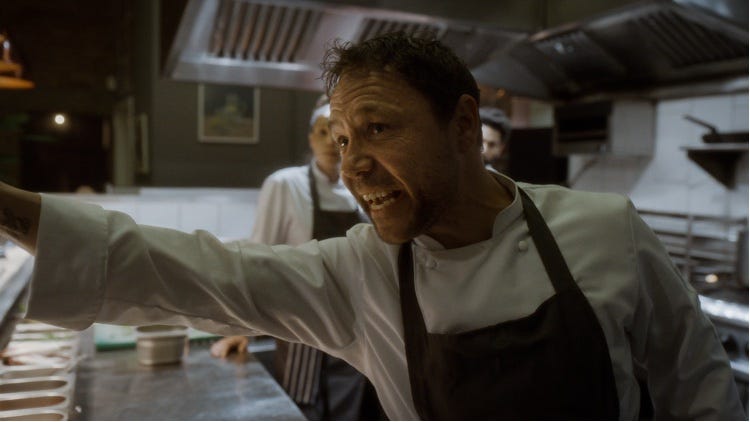
The second film we discussed is Boiling Point, Philip Bartantini’s 2021 high-tension portrait of a chef at the end of his rope. The entire film is done in one take, which lends an intensity meant to mirror what the characters are feeling. The ecosystem described in New Rules becomes a battlefield as personalities, patrons, and pressures collide and lead to a crisis. In The Menu, none of the food is prepared with any heart; in Boiling Point, every interaction is fraught with emotions which spill over into the different spaces tracked by the camera. In the film’s unnamed restaurant, the brigade system hangs by a thread: animosity between the front- and back-of-house, cluttered and claustrophobic spaces, the sound of the point-of-sale ticket printers, and the smarminess of health inspectors are all components of restaurant life that Reiner has experienced firsthand. In his reaction to the film, he speaks about how a table of social media influencers’ requests for off-menu steaks illustrates the need for structure and limits: “If you don’t have these rules, the restaurant will descend into chaos and this is what the chaos looks like.”
In The New Rules, Reiner states, “With so many variables at play simultaneously … entropy is inevitable” and advises readers how to “manage their tolerance for imperfections.” This is exactly what some of the guests in Boiling Point refuse to do.
Reiner closes his book by urging the importance of advocating for one’s favorite local restaurants through patronage. Word of mouth is great, but giftcards and showing up are what keep these places open. People are disappointed to learn that a neighborhood mainstay is closing and then note that they haven’t been there in years: “We expect these restaurants to always be there when we need them, but we rarely show the same commitment in return.” I was reminded of my recent comments-section back-and-forth with Winston Malone about the importance of independent bookstores, which serve a similar function in heading off cultural homogenization. Every pizza you buy from the local guys is one less Dominos doormat working its way into your home and across the fruited plain.
Bon appetit!
Adam Reiner’s writing has appeared in Food and Wine, New York Magazine, and recently the Wall Street Journal, which featured his piece “What Your Waiter Really Thinks of You.” You can read the piece for which he won the 2025 James Beard Award for Feature Reporting, “We Need to Talk About Trader Joe’s,” here. Listen to the interview below or wherever you get podcasts. Please consider subscribing and leaving a review. Thanks for reading.


