


You can watch the interview in the player above or listen wherever you get podcasts.
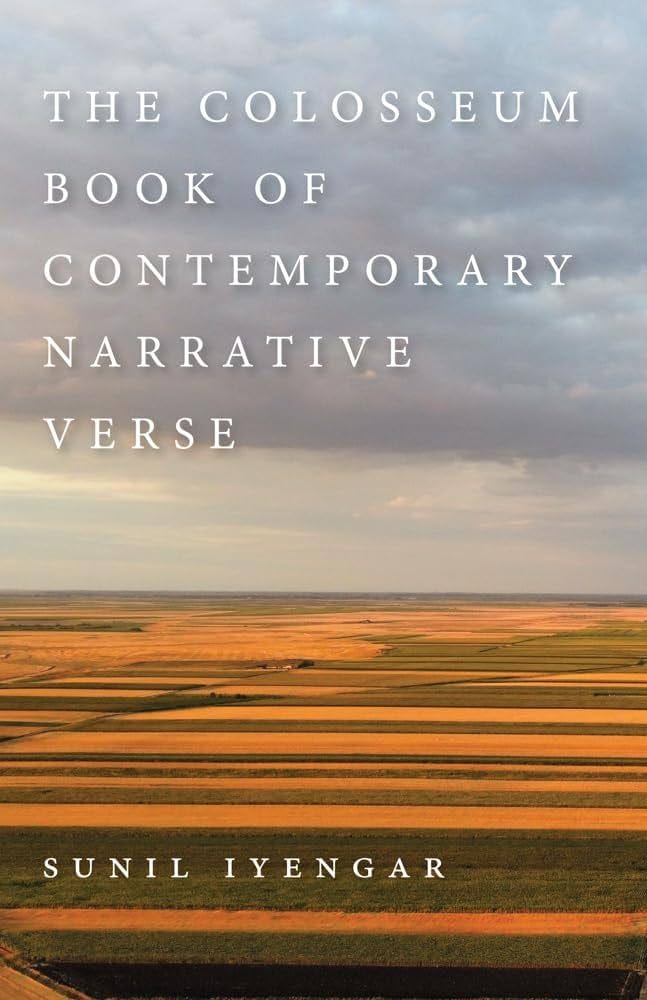
Sunil Iyengar has a mission: to get us reading more narrative verse. He envisions a future in which anthologies and guides to poetry will have “sections about character, plot, setting, and dialogue alongside standard entries on verbal music, lineation, stanza shapes, and other conspicuous aspects of verse” (xx). Mid-length narrative poems have become, to some readers (and writers) passé: lyric trumps narrative, and in our main-character-heavy age, lyrical examinations of one’s troubled, divided, or traumatized self are all the rage. They seem to have, in some circles, greater cultural clout. Telling a story? Really? Wasn’t that over with “The Raven,” the Ancient Mariner, and “Casey at the Bat?”
Actually, no. In The Colosseum Book of Contemporary Narrative Verse, Iyengar has collected forty-nine poems by twenty-eight poets writing from the 1950s until 2024. If, like me, your list of memorized and favorite poems stops in the mid-sixties, there are some names you’ll recognize, like Rita Dove and Bob Dylan, but there are far more whose work you’ll encounter here for the first time. Being made aware of a blind spot isn’t pleasant in a relationship, but in reading it’s always a great experience: I had assumed that almost nobody cared any longer about meter or structure, but (as I’ve been in the past) I was gloriously wrong. There are terrific poems in here, like Charles Martin’s “Passages from Friday,” Sydney Lea’s “The Feud,” Joshua Mehgan’s “The Pig Roast,” and Gjertud Schnackenberg’s “Two Tales of Clumsy” that I never would have read were it not for this anthology. The poems are largely traditional in form—many recall the blank verse of “Home Burial” or the tight stanzas of Emily Dickinson—and will remind readers of the sounds that make verse worth reading.
When I interviewed Sunil for the New Books Network, the first thing I asked him was about his claim in the Introduction that to read these poems was to “witness a quiet revolution in literary sensibility” (ix). He replied:
The revolution factor has to do with this: going back to the dawn of English language poetry, you’ve had epics and tales. Everyone knows the names of some of them—long narrative poems by most of the greats. But I would say after twentieth-century modernism, particularly, there’s what I call the supremacy of the lyric. This is a sort of disproportionate valuing of different components of lyric poetry, such as sound, image, the integrity of the line. I mean, I love a lot of his work, but John Ashbery and the poets of that, I won’t even say “that generation” necessarily, but there’s a certain kind of poet who really thrives on disjunctions, right? And what, you know, are kind of a stream of non-sequiturs, but are brilliant and create a sort of sorcery of language, but don’t necessarily push or have a momentum in terms of narrative, as we would think of it.
I think there’s a little bit of that in the air as well, especially the turn of the last century, which may have inhibited some of the more straight-up narrative poems. And when I say “straight-up,” let me be clear, it’s not that it just tells a story and that’s it—then you can just do that in prose. Clearly every line has to carry its own weight and has to be a poem in every way.
When I responded that the poems here do carry their weight as verse and said that I read many of these out loud to myself at the kitchen table, he was very happy to hear that.
One of the poems in the anthology is Rachel Westzsteon’s “Madeline for a While.” It’s a retelling of Hitchcock’s Vertigo in a form that we don’t see that often: a pantoum, a form created in Malaysia, imitated by the French, and occasionally found in English. A pantoum consists of four-line stanzas, but the challenge for the poet is that the second and fourth lines of each stanza become the first and third line of the next. The repetition subtly changes and enhances the meaning of individual lines and Westzsteon’s repetitions are never forced. The same line placed in a new stanza takes on a different meaning and adds to the overall effect. It’s an incredible performance.
Here’s the poem in full:
Madeline for a While
after Hitchcock’s VertigoScottie looked down from a very great height,
and as Midge sat primly at her easel
he talked himself back into wholeness:
“I look up, I look down, I look up, I look...”As Midge sat primly at her easel
he followed Madeleine through the city.
“I look up, I look down, I look up, I look...”
Down he fell all over again.He followed Madeleine through the city;
the ghost of mad Carlotta steered her.
Down he fell all over again:
she jumped in the water and he jumped after.The ghost of mad Carlotta steered her:
“There’s someone within me, and she says I must die.”
She jumped in the water and he jumped after;
they kissed in the shade of ancient sequoias.“There’s someone within me, and she says I must die.”
Haunted Madeleine mounted the steps.
They kissed in the shade of ancient sequoias,
they parted when she leaped from the tower.Haunted Madeleine mounted the steps;
Scottie pursued, obsessed and dizzy.
They parted when she leaped from the tower,
they met again in a crowded rush hour.Scottie pursued, obsessed and dizzy.
An ill-lit corridor led to her room.
They met again in a crowded rush hour;
They argued in her fleabag hotel.An ill-lit corridor led to her room;
Judy’s dark hair confused the picture.
They argued in her fleabag hotel.
“Be Madeleine for a while,” he begged.Judy’s dark hair confused the picture,
ruining the marvelous story.
“Be Madeleine for a while,” he begged,
so she returned a dazzling blonde.Ruining the marvelous story,
her necklace revealed all she had been
when she returned a dazzling blonde.
Holding Madeleine, he’d embraced air.Her necklace revealed all she had been:
a stumble, a wail, a plunge into darkness.
Holding Madeleine, he’d embraced air.
One final thing and he would be free.A stumble, a wail, a plunge into darkness.
He talked himself back into wholeness:
one final thing and he would be free.
Scottie looked down from a very great height.
In this episode, Sunil and I talk about the joy of rewatching Vertigo and the ways in which the sounds, images, and repetitions of “Madeline for a While” complement the film. Alexander Pope told us that the sound should seem an echo to the sense, and the sounds and other effects of Vertigo—the rhythms, the music, the dialogue, the images, and the many repetitions—perfectly match its story of a haunted man who loses his beloved … twice.
If you haven’t bought a poetry anthology in a long time, The Colosseum Book of Contemporary Narrative Verse is worth a look. You can find it here on its publisher’s website or wherever you buy books.
CREDIT: Rachel Wetzsteon, “Madeleine for a While” from Sakura Park. Copyright © 2006 by Rachel Wetzsteon. Reprinted with the permission of Persea Books, Inc (New York), www.perseabooks.com. All rights reserved.


